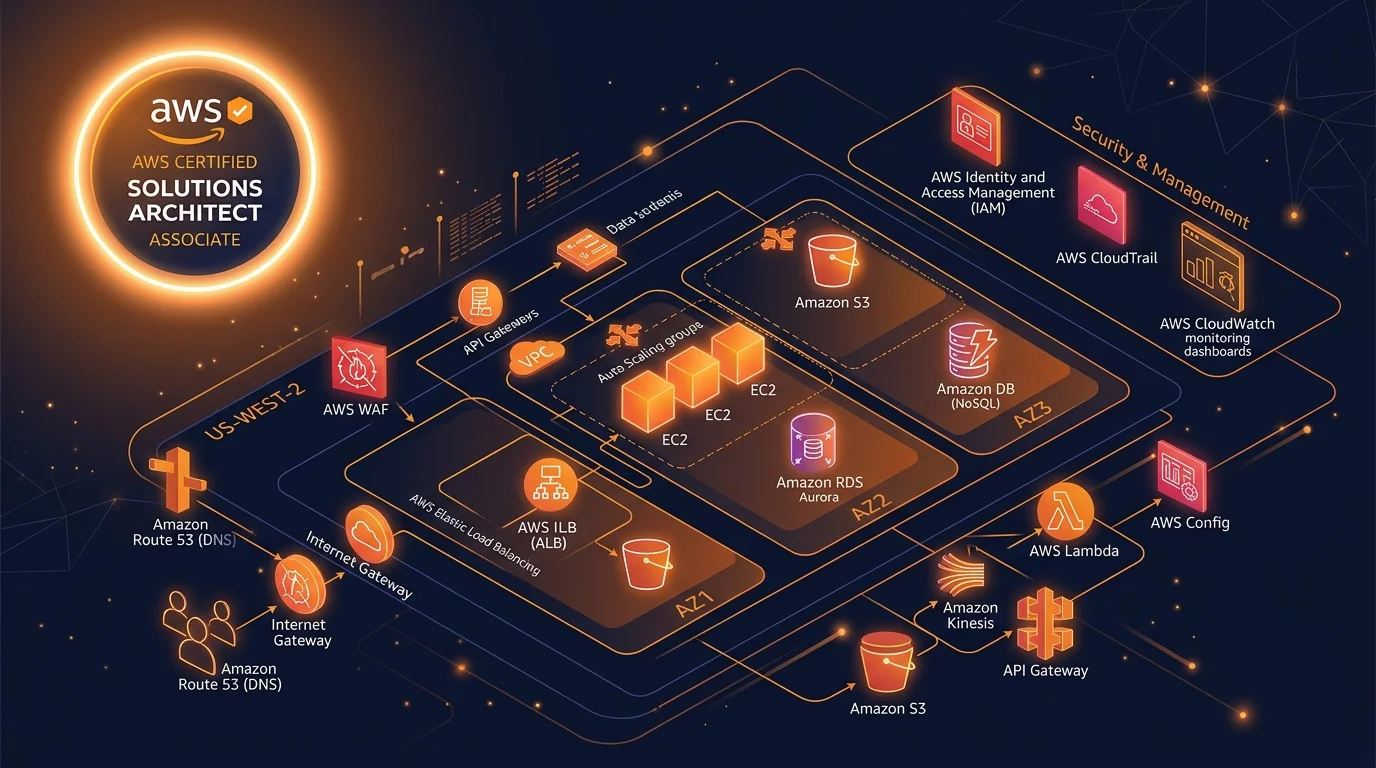
The AWS Certified Solutions Architect – Associate (SAA-C03) is widely regarded as the gold standard cloud certification in enterprise IT. Unlike entry-level foundational credentials like the AWS Cloud Practitioner, which test high-level vocabulary, the SAA-C03 examination places candidates into real-world scenario simulations. You are challenged to design resilient multi-tier web applications, optimize high-throughput storage pipelines, enforce least-privilege IAM security governance, and engineer catastrophic disaster recovery failover architectures.
Earning this credential consistently unlocks salary thresholds exceeding $130,000 to $160,000 globally, serving as a primary stepping stone into senior Cloud Architect, DevOps Engineer, and Site Reliability Engineer (SRE) roles. In this comprehensive 60-day roadmap, we break down the official 4 exam domains, construct an enterprise-grade Multi-AZ Virtual Private Cloud (VPC), compare storage tier economics across Amazon S3, EBS, and EFS, and review the Six Pillars of the AWS Well-Architected Framework. Benchmark your compensation upside using our Tech Salary & Bootcamp ROI Calculator, or review your foundational roadmap in our AWS Cloud Practitioner Study Guide.
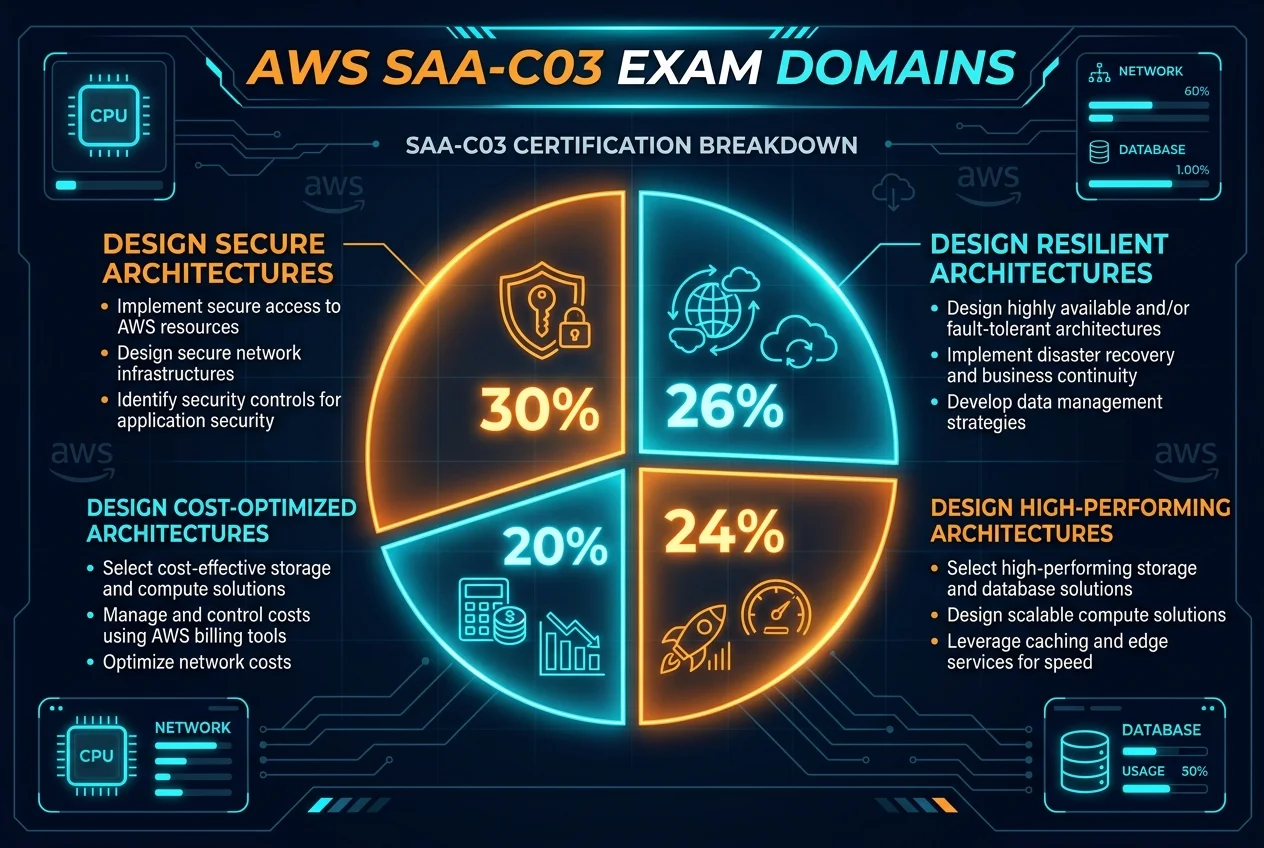
| Exam Domain | Weighting (%) | Core Architectural Services Tested | Target Passing Confidence |
|---|---|---|---|
| Domain 1: Design Secure Architectures | 30% | IAM policies, KMS envelope encryption, Security Groups, NACLs, AWS Secrets Manager, WAF | High (Memorize least privilege & cross-account roles) |
| Domain 2: Design Resilient Architectures | 26% | Multi-AZ RDS, Aurora Global DB, Auto Scaling Groups, Route 53 routing policies, SQS decoupling | Critical (Focus on fault tolerance & RTO/RPO targets) |
| Domain 3: Design High-Performing Architectures | 24% | ElastiCache (Redis/Memcached), CloudFront edge caching, DynamoDB DAX, EBS volume types (gp3 vs io2) | High (Know when to cache reads vs scale compute) |
| Domain 4: Design Cost-Optimized Architectures | 20% | S3 Glacier Lifecycle rules, Savings Plans, Spot Instances, Compute Optimizer, AWS Graviton | Medium (Match workload profiles to cheapest tier) |
Understanding the 4 Exam Domains of SAA-C03
To conquer the exam on your first attempt, you must understand how AWS structures scenario evaluation. The exam consists of 65 multiple-choice and multiple-response questions administered across 130 minutes. The passing score is 720 out of 1000 on a scaled scoring curve.
Every scenario question is written defensively. Questions typically conclude with specific optimization qualifiers: “Which solution meets these requirements MOST cost-effectively?” or “Which architecture provides the HIGHEST availability with the lowest operational overhead?” Memorizing definitions will result in failure; you must understand trade-offs between managed services, compute types, and networking topologies.
Constructing an Enterprise Multi-AZ VPC Architecture
Networking is the structural backbone of the Solutions Architect examination. If you cannot configure a Virtual Private Cloud (VPC) from memory, you will struggle across all 4 domains. A production-ready enterprise AWS architecture mandates a minimum of two Availability Zones (AZs) with isolated public, private application, and private database subnets.

Let us analyze the traffic flow through this resilient topology:
- Edge & Public Subnets: Incoming internet traffic enters via an Internet Gateway (IGW) and hits an external Application Load Balancer (ALB) spanning multiple public subnets. Each public subnet contains a dedicated NAT Gateway to provide outbound internet connectivity for private backend nodes without exposing them to inbound exploits.
- Private Application Subnets: EC2 web and backend application instances reside in private subnets with no public IP addresses. These instances are governed by an Auto Scaling Group (ASG) that dynamically expands and contracts compute capacity based on CloudWatch CPU utilization or target tracking metrics.
- Isolated Database Subnets: Relational data tiers—such as Amazon RDS PostgreSQL or MySQL—operate in isolated private database subnets with routing tables restricted solely to internal VPC traffic. In a Multi-AZ deployment, synchronous replication maintains an active primary in AZ-1 and a warm standby replica in AZ-2. If hardware failure strikes AZ-1, DNS automatically flips to AZ-2 in under 60 seconds with zero manual intervention.
Core AWS Storage Services: Performance & Cost Trade-Offs
Storage questions appear in nearly 25% of exam scenarios. The test frequently asks you to choose the exact storage tier that satisfies throughput, latency, and lifecycle retention requirements at minimum spend.
| AWS Storage Service | Storage Type | Access Latency | Primary Use Case Scenario | Relative Cost |
|---|---|---|---|---|
| Amazon S3 Standard | Object Storage | Milliseconds | Frequently accessed active web assets, big data lakes, raw files | Base ($0.023 / GB) |
| S3 Standard-Infrequent Access | Object Storage | Milliseconds | Disaster recovery copies, end-of-month financial audit records | Low storage fee + retrieval fee |
| S3 Glacier Flexible Retrieval | Archival Object | Minutes to hours | Long-term compliant backups accessed fewer than once per year | Ultra-low (~$0.0036 / GB) |
| S3 Glacier Deep Archive | Deep Archival | 12 to 48 hours | Healthcare and financial records retained 7–10 years for compliance | Cheapest (~$0.00099 / GB) |
| Amazon EBS (gp3) | Block Storage | Sub-millisecond | Boot volumes and active databases attached to single EC2 instances | Medium ($0.08 / GB + provisioned IOPS) |
| Amazon EFS | Managed Network File (NFS) | Low millisecond | Shared concurrent storage accessed by hundreds of EC2 Linux nodes | Higher ($0.30 / GB standard) |
Decoupling Architectures: Amazon SQS, SNS, and EventBridge
Monolithic systems fail when downstream components experience traffic spikes. AWS heavily emphasizes loose coupling to ensure resilience. The SAA-C03 exam rigorously tests your ability to distinguish between message queuing, pub/sub notifications, and event-driven orchestration:
- Amazon Simple Queue Service (SQS): A pull-based asynchronous queuing system. Use standard queues for nearly unlimited throughput with best-effort ordering, or FIFO (First-In-First-Out) queues when strict message sequencing and exactly-once processing are mandatory. SQS acts as a buffer between web frontends and backend compute workers, absorbing sudden viral surges without dropping transactions.
- Amazon Simple Notification Service (SNS): A push-based publisher/subscriber fanout engine. When an order event triggers, an SNS topic fans out notifications simultaneously to multiple endpoints: triggering an AWS Lambda function, pushing to an SQS analytics queue, and dispatching SMS/email receipts to customers.
- Amazon EventBridge: A modern serverless event bus that routes real-time schema-governed events from AWS services, custom applications, and SaaS integrations (like Datadog, Zendesk, or PagerDuty) directly to serverless processing targets.
The 60-Day AWS Solutions Architect Study Plan
Achieving SAA-C03 certification within 8 weeks requires structured, disciplined execution combining video theory, hands-on console building, and simulated mock exams.
Weeks 1–2: Cloud Fundamentals, Global Infrastructure & IAM
- Master AWS Global Infrastructure: Regions, Availability Zones, Local Zones, and Edge Locations.
- Configure AWS Organizations, Service Control Policies (SCPs), and IAM roles with condition keys.
- Implement AWS KMS Customer Managed Keys (CMKs) with envelope encryption.
Weeks 3–4: Core Compute, High Availability & VPC Networking
- Provision custom VPCs with CIDR block segmentation, route tables, IGWs, and NAT Gateways.
- Deploy Auto Scaling Groups behind Application Load Balancers with custom target health checks.
- Establish hybrid connectivity: AWS Site-to-Site VPN, Direct Connect, and AWS Transit Gateway.
Weeks 5–6: Databases, Storage Lifecycle & Decoupling
- Compare RDS Multi-AZ synchronous failover against read replica asynchronous performance scaling.
- Build serverless event architectures with AWS Lambda, API Gateway, DynamoDB, and SQS dead-letter queues.
- Implement automated S3 Lifecycle Rules transitioning staging data to Glacier Flexible Retrieval.
Weeks 7–8: Full-Length Mock Exams & Exam Strategy
- Complete at least 5 to 6 full-length timed mock exams (aim for consistent 85%+ scores before testing).
- Carefully review every incorrect answer and identify subtle question distractors.
- Take your exam either online via Pearson VUE remote proctoring or at an authorized testing center.
Frequently Asked Questions (FAQ)
How long does it take to prepare for the AWS SAA-C03 exam?
Preparation typically takes between 4 to 8 weeks for candidates with basic IT familiarity, and 60 to 90 days for beginners completing hands-on labs.
Which practice exams best simulate the real AWS Solutions Architect test?
Tutorials Dojo (Jon Bonso) and Stephane Maarek practice exams are industry standards for simulating actual SAA-C03 questions and time pressure.
What is the difference between an Application Load Balancer (ALB) and a Network Load Balancer (NLB)?
ALBs operate at Layer 7 with advanced HTTP routing, while NLBs operate at Layer 4 offering ultra-high throughput and static IP addresses.
Do I need to pass the AWS Cloud Practitioner before taking the Solutions Architect Associate?
No, AWS enforces no prerequisites; you can take the Solutions Architect Associate exam directly.