
Transitioning into modern infrastructure engineering requires a clear, disciplined strategy; following an industry-aligned devops roadmap for beginners eliminates the confusion of learning dozens of disjointed tools in the wrong order. DevOps is not merely a job title—it is an organizational culture and engineering practice that unites software development (Dev) with IT operations (Ops) to deliver high-quality software continuously and reliably. In this comprehensive beginner roadmap, you will progress step-by-step through Linux systems, containerization with Docker, orchestration with Kubernetes, CI/CD pipeline automation, and Infrastructure as Code (IaC) with Terraform.
| Roadmap Milestone | Primary Focus Domain | Essential Tool Stack | Estimated Timeline |
|---|---|---|---|
| Phase 1: Operating Systems & Networking | Linux CLI, Bash scripting, TCP/IP, DNS, SSH | Ubuntu, Bash, Vim, OpenSSH, curl, netstat | Weeks 1–4 |
| Phase 2: Version Control & GitOps | Branching strategies, pull requests, merge conflict resolution | Git, GitHub, GitLab, Trunk-Based Development | Weeks 5–6 |
| Phase 3: Containerization & Packaging | Container runtimes, image building, multi-stage Dockerfiles | Docker, Docker Compose, Container Registries | Weeks 7–10 |
| Phase 4: CI/CD Pipeline Automation | Automated testing, build pipelines, artifact management | GitHub Actions, Jenkins, SonarQube, ArgoCD | Weeks 11–14 |
| Phase 5: Cloud & Infrastructure as Code | Cloud provisioning, declarative architecture, state management | AWS, Terraform, OpenTofu, Ansible | Weeks 15–18 |
| Phase 6: Orchestration & Observability | Cluster scheduling, service discovery, metrics, alerting | Kubernetes, Helm, Prometheus, Grafana | Weeks 19–24 |
What Is DevOps and Why Is It One of Tech’s Highest-Paid Specializations?
Historically, software developers wrote application code and threw it over the wall to system administrators, who were responsible for manually deploying and maintaining it on physical servers. When deployments failed, developers blamed system administrators for server configuration drift, while sysadmins blamed developers for buggy application code. DevOps emerged to dismantle these organizational silos by automating repetitive deployment tasks, treating infrastructure as software, and enforcing shared responsibility across the entire software delivery lifecycle.
According to research published by the U.S. Bureau of Labor Statistics, cloud and network infrastructure engineering roles are among the fastest-expanding technical occupations in the global technology sector. Organizations that master automated continuous delivery deploy code hundreds of times faster and experience significantly lower change failure rates than legacy operations teams.
Before beginning your technical studies, understanding career milestones and realistic compensation projections is essential. You can benchmark entry-level and senior salaries using our interactive Tech Salary & Bootcamp ROI Calculator or map your multi-month learning roadmap using our free Career Roadmap Planner.
Understanding the DevOps Continuous Lifecycle
At the center of all DevOps methodologies sits the continuous feedback loop—commonly illustrated as an infinity loop. This framework emphasizes that software engineering is not a one-time handoff, but an ongoing cycle of iterative enhancements and real-time operational feedback.
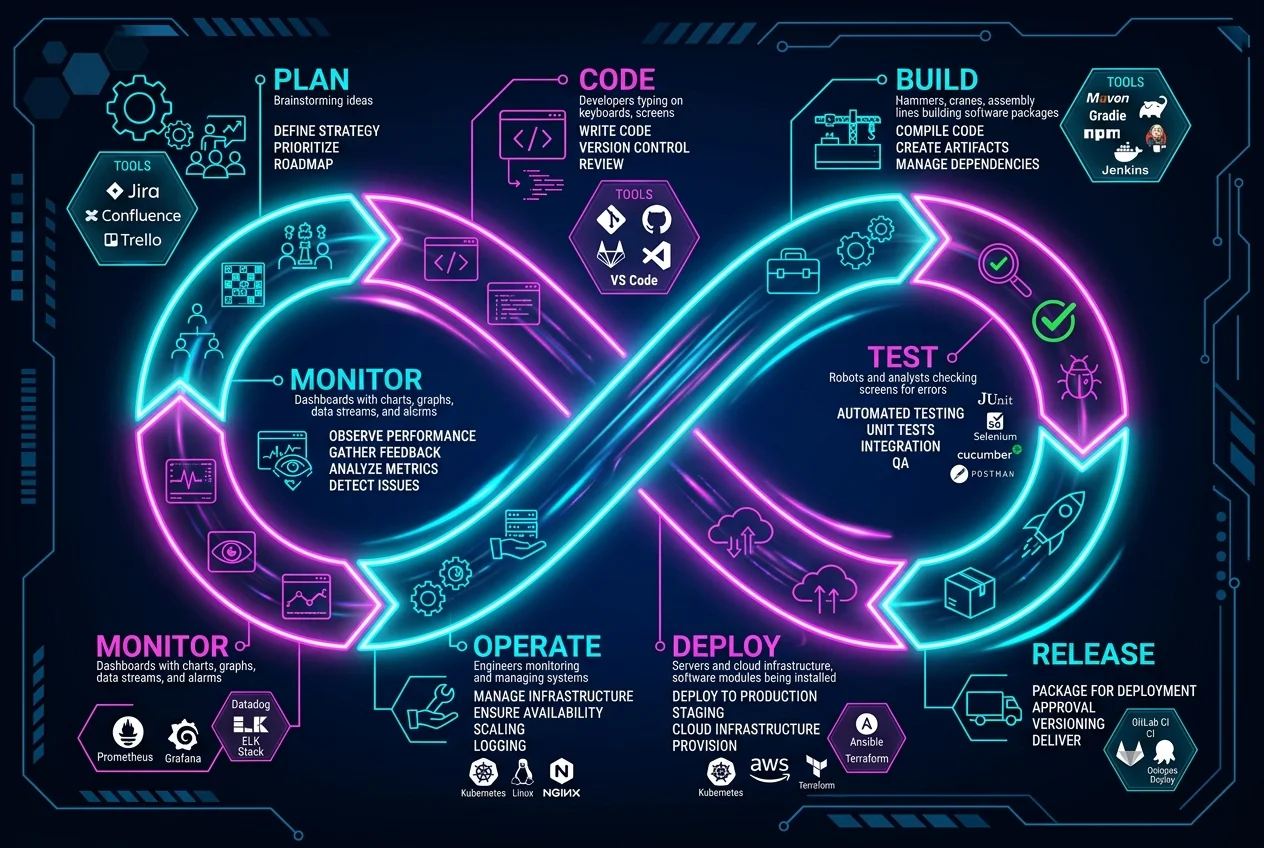
Figure 1: The continuous DevOps infinity loop connecting development and operational engineering.
The Eight Stages of the Continuous Lifecycle
- 1. Plan: Product teams define feature backlogs, user stories, and technical requirements using issue tracking tools such as Jira, Trello, or GitHub Projects.
- 2. Code: Software engineers write code in languages like Go, Python, or TypeScript, collaborating through Git version control repositories.
- 3. Build: Automated build runners pull source code, compile binaries, download third-party package dependencies, and assemble release packages.
- 4. Test: Automated testing suites execute unit tests, integration tests, end-to-end regression suites, and static application security testing (SAST).
- 5. Release: Successful builds are version-tagged, packaged into immutable container images, and stored in enterprise container registries.
- 6. Deploy: Deployment engines roll out release packages to staging and production cloud infrastructure with zero downtime.
- 7. Operate: Systems administrators manage cloud resources, dynamic autoscaling policies, database failover clusters, and high-availability routing.
- 8. Monitor: Telemetry systems collect application metrics, distributed traces, and log streams to alert engineers to anomalies before users are impacted.
Phase 1: Operating Systems, Linux Internals & Bash Scripting
Over 90% of enterprise cloud infrastructure runs on Linux distributions (such as Ubuntu, Debian, Red Hat Enterprise Linux, and Rocky Linux). If you cannot navigate a headless server via the command-line interface (CLI), you cannot operate as a DevOps engineer.
Core Linux Competencies You Must Master
- Filesystem Hierarchy & Navigation: Understand the purpose of standard directories (
/etcfor configuration,/var/logfor application logs,/optfor third-party software, and/homefor user profiles). - File Permissions & Ownership: Master POSIX permissions (read, write, execute), octal notation (e.g.,
chmod 755,chmod 600), and ownership assignment withchown. - Process Management: Monitor system resource consumption using
top,htop,ps aux, and manage background daemon services usingsystemctlandjournalctl. - Networking Fundamentals: Understand OSI model layers, IP addressing, subnetting, DNS resolution, and diagnose network connectivity using
curl,ping,dig,netstat, andtraceroute. - Bash Automation: Write modular shell scripts utilizing conditional logic, loops, environment variables, exit codes, and pipe operators (
|,>,>>,grep,sed,awk).
Phase 2: Version Control, Git Architecture & Collaboration
Version control is the bedrock of modern infrastructure automation. In DevOps, not only application source code is tracked in Git; server configuration files, Dockerfiles, and cloud infrastructure declarations are all versioned in Git repositories—a methodology known as GitOps.
Beginners must move beyond basic git commit and master professional Git workflows: feature branching strategies, rebasing versus merging, resolving merge conflicts cleanly, and configuring pre-commit hooks to prevent secret keys and credentials from being accidentally committed to public repositories.
Phase 3: Containerization with Docker
Before containers, applications suffered from the infamous “it works on my machine” problem. Developers built applications on macOS or Windows laptops, but when the code was deployed onto production Linux servers with different library versions, the application crashed. Docker solves this by packaging code alongside its exact runtime dependencies, libraries, and configuration into lightweight, portable, immutable containers.
Essential Docker Building Blocks
- The Dockerfile: A text recipe containing instructions to assemble a container image (e.g.,
FROM,WORKDIR,COPY,RUN,EXPOSE,CMD). - Multi-Stage Builds: A critical production technique that uses separate build and runtime stages to produce minimal, secure container images under 50MB.
- Docker Compose: A declarative YAML tool for defining and orchestrating multi-container local environments (e.g., spinning up a web server, Redis cache, and PostgreSQL database with a single command).
Phase 4: Continuous Integration & Continuous Deployment (CI/CD)
CI/CD is the operational engine that turns code commits into live, running software. Automated pipelines ensure that every single code change is thoroughly tested, scanned for vulnerabilities, and deployed without manual human intervention.
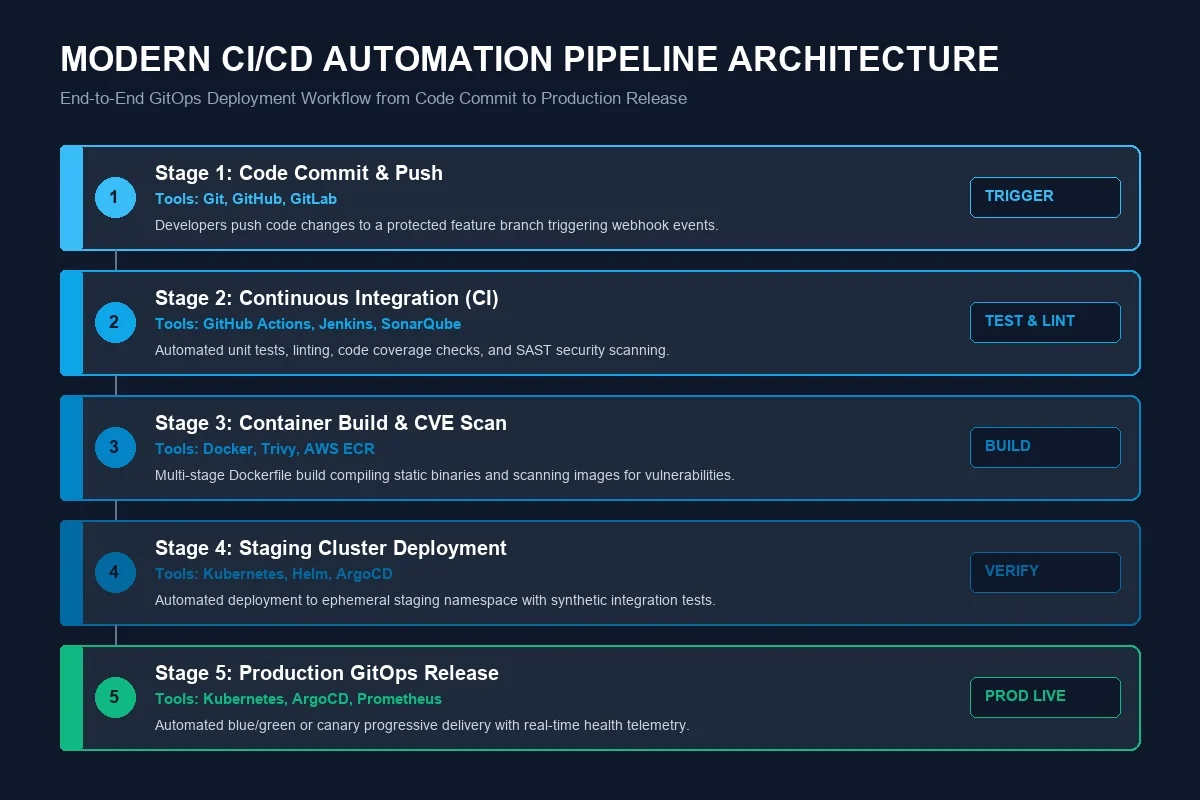
Figure 2: The five core stages of an enterprise CI/CD automation pipeline.
Anatomy of a Production CI/CD Pipeline
- Trigger: A developer creates a pull request or merges code into the
mainbranch on GitHub or GitLab. - Continuous Integration (CI): A remote runner VM automatically spins up, executes unit tests, performs code linting, and runs security vulnerability checks.
- Artifact Packaging: The runner builds a production Docker container image, tags it with the Git commit SHA, and pushes it to a secure container registry (such as AWS ECR or GitHub Container Registry).
- Staging Deployment: The container image is automatically deployed to a non-production staging cluster, where integration and load tests run.
- Production Release (CD): Upon passing automated verification, the update is deployed to production using zero-downtime rolling update or canary deployment strategies.
For engineers preparing for technical screenings that test data manipulation and backend database queries, review our detailed guide on the SQL Interview Cheat Sheet to master 20 tested query patterns, or explore our foundational guide on How to Learn SQL in 30 Days.
Phase 5: Cloud Architecture & Infrastructure as Code (IaC)
Modern DevOps engineers do not click through cloud provider consoles to create virtual machines and databases manually. Manual provisioning is slow, error-prone, and impossible to reproduce accurately across multiple environments. Instead, engineers declare their desired infrastructure in code files using Terraform or OpenTofu.
By declaring cloud infrastructure in code, your entire data center architecture can be peer-reviewed, tested in pull requests, version-controlled, and recreated in any cloud region in minutes. If you are starting your cloud learning journey, we recommend studying our comprehensive AWS Cloud Practitioner Study Guide to master core compute, storage, VPC networking, and security concepts.
Phase 6: Container Orchestration with Kubernetes
While Docker is exceptional for running individual containers, enterprise applications require hundreds of microservice containers running across distributed clusters of servers. Kubernetes (K8s) is the industry-standard container orchestration platform that manages container scheduling, automatic healing, horizontal autoscaling, and zero-downtime rolling deployments.
Core Kubernetes Concepts Every Beginner Must Know
- Pods: The smallest deployable unit in Kubernetes, wrapping one or more tightly coupled containers sharing network and storage namespaces.
- Deployments: Declarative controllers that manage Pod replica counts, rolling updates, and rollbacks.
- Services: Persistent network endpoints and internal load balancers that route traffic to ephemeral Pod instances.
- Ingress Controllers: HTTP/HTTPS reverse proxies that route external internet traffic to internal cluster services based on hostnames and URL paths.
- Helm: The package manager for Kubernetes that packages complex multi-resource manifests into versioned, reusable charts.
Phase 7: Building a DevOps Portfolio That Gets You Hired
DevOps hiring managers care far more about proven, verifiable infrastructure code than theoretical certifications. To stand out among junior applicants, build two or three production-grade public GitHub repositories that showcase end-to-end automation. If you need inspiration for projects that demonstrate commercial architectural standards, use our free Portfolio Project Generator.
Three Portfolio Projects to Build:
- Project 1: Multi-Environment Cloud Infrastructure with Terraform: Build a Terraform repository that provisions a modular AWS VPC, public/private subnets, an RDS PostgreSQL database, and an ECS or EKS cluster with separated
devandprodenvironments using Terraform workspaces and remote S3 state locking. - Project 2: Complete GitOps CI/CD Pipeline: Configure a GitHub Actions workflow for a containerized web application that runs tests, builds a minimal multi-stage Docker image, scans it with Trivy, and triggers an automated deployment via ArgoCD to a local Minikube or cloud Kubernetes cluster.
- Project 3: Observability Stack with Prometheus & Grafana: Deploy Prometheus and Grafana on Kubernetes, configure Node Exporter to gather server metrics, and build an executive monitoring dashboard with automated Slack alerts for CPU throttling and high error rates.
For professionals seeking cross-disciplinary skills in analytics and business intelligence to complement infrastructure management, review our comprehensive roadmap on Top 5 Data Analytics Certifications Guide and our step-by-step curriculum on Financial Modeling Roadmap.
Frequently Asked Questions About DevOps Roadmaps
How long does it take to learn DevOps from scratch?
For individuals with basic IT or programming foundations, reaching junior-level DevOps competence typically requires 6 to 9 months of consistent, hands-on daily study (15 to 20 hours per week). Complete beginners with no prior Linux or networking experience should budget 9 to 12 months.
Do I need to learn software programming to become a DevOps engineer?
Yes, but you do not need to be an expert full-stack developer. You must be comfortable writing automation scripts, reading application error logs, and understanding basic API structures. Python, Bash, and Go are the three most valuable languages for DevOps engineers.
Should I learn Docker before learning Kubernetes?
Absolutely. Kubernetes is a container orchestrator designed to manage containers. Attempting to learn Kubernetes before understanding Docker container images, Dockerfiles, volumes, and networking is the most common reason beginners feel overwhelmed.
Which cloud provider should a DevOps beginner start with?
Amazon Web Services (AWS) is strongly recommended for beginners because it holds the largest global market share and has the highest number of job postings. The foundational concepts you learn on AWS (VPCs, IAM roles, virtual servers, managed databases) transfer directly to Google Cloud Platform (GCP) and Microsoft Azure.
What is the difference between DevOps and Site Reliability Engineering (SRE)?
DevOps is a broad cultural philosophy and set of operational practices focusing on fast, continuous delivery. Site Reliability Engineering (SRE)—originally pioneered by Google—is a specific implementation of DevOps principles that uses software engineering techniques to solve infrastructure problems and ensure high system availability (SLAs, SLOs, error budgets).