Preparing for your first cloud certification can feel overwhelming, but following a structured aws cloud practitioner study guide is the fastest, most reliable way to pass the AWS Certified Cloud Practitioner (CLF-C02) exam on your first attempt. In this comprehensive study guide, you will master the four essential exam domains, explore core AWS infrastructure, practice real scenario questions, and execute a day-by-day 30-day study plan designed for beginners with zero prior cloud engineering experience.
| Exam Feature | CLF-C02 Specification | Recommended Candidate Benchmark |
|---|---|---|
| Exam Format | 65 multiple-choice or multiple-response questions | Scored 100–1,000 (Passing score: 700) |
| Exam Duration | 90 minutes | Average completion time: 45–55 minutes |
| Exam Cost | $100 USD | Eligible for 50% discount voucher on future exams |
| Target Role Level | Foundational / Entry-Level | Beginners, Career Switchers, Project Managers, Analysts |
| Prerequisites | None (General IT awareness recommended) | 30 days of consistent study (1–2 hours daily) |
What is the AWS Certified Cloud Practitioner (CLF-C02) Exam?
The AWS Certified Cloud Practitioner (exam code CLF-C02) is Amazon Web Services’ foundational credential. Unlike specialty associate certifications such as Solutions Architect or DevOps Engineer, this certification validates overall cloud literacy, high-level architectural knowledge, shared security responsibilities, and financial governance.
Whether you are transitioning from business operations, software engineering, data analytics, or non-technical project management, mastering the AWS Cloud Practitioner curriculum gives you the shared vocabulary needed to communicate effectively with enterprise cloud architects and infrastructure teams. If you are balancing this study roadmap with analytical tool mastery, you can calculate your weekly commitment using our Career Roadmap Planner to build a customized study timeline.
The 4 Core CLF-C02 Exam Domains Explained
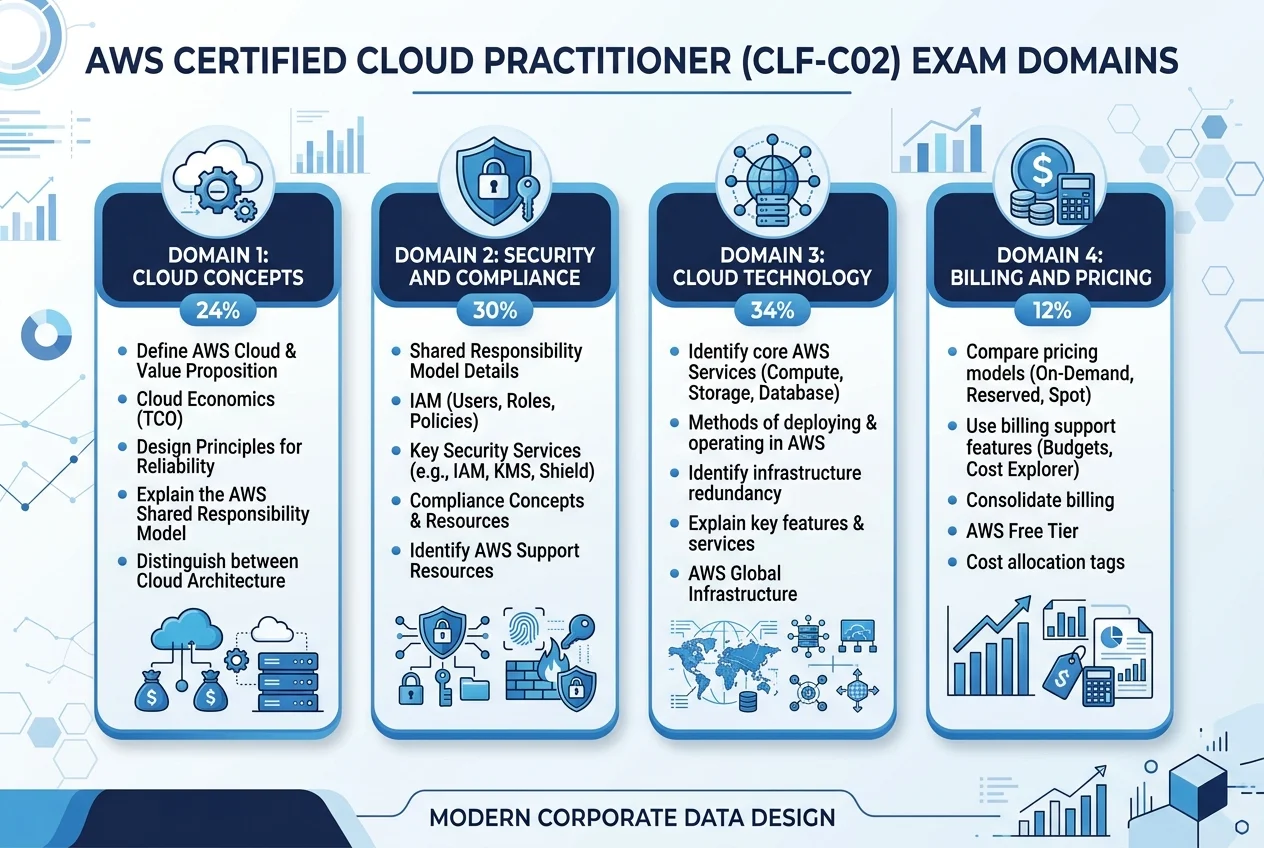
To pass the CLF-C02 certification, you must understand how AWS distributes exam questions across four primary domains. Each domain evaluates specific competencies:
Domain 1: Cloud Concepts (24% of Exam)
This domain evaluates your understanding of fundamental cloud economics, architectural agility, and deployment models:
- Definition of the AWS Cloud: The on-demand delivery of compute power, database storage, applications, and other IT resources via the internet with pay-as-you-go pricing.
- Six Advantages of Cloud Computing: Trade capital expense for variable expense, benefit from massive economies of scale, stop guessing capacity, increase speed and agility, stop spending money running data centers, and go global in minutes.
- Cloud Architecture Principles: Design for failure, loose coupling between services, horizontal scaling versus vertical scaling, and elastic automated provisioning.
- The AWS Well-Architected Framework: Six foundational pillars—Operational Excellence, Security, Reliability, Performance Efficiency, Cost Optimization, and Sustainability.
Domain 2: Security and Compliance (30% of Exam)
Security accounts for nearly a third of all questions on the CLF-C02 exam. Candidates must know precisely where AWS security ends and customer security begins:
- AWS Shared Responsibility Model: AWS is responsible for security OF the cloud (physical hardware, facilities, virtualization software, data center network). The customer is responsible for security IN the cloud (customer data, IAM credentials, operating system patches on EC2, firewall rules via Security Groups).
- AWS Identity and Access Management (IAM): Principles of least privilege, root user protection (mandatory Multi-Factor Authentication), IAM Users, User Groups, IAM Roles (for temporary service credentials), and JSON IAM Policies.
- Key Security Services: AWS Shield (DDoS mitigation), AWS WAF (web application firewall filtering Layer 7 HTTP exploits), AWS KMS (cryptographic key management), and AWS Inspector (automated vulnerability scanning).
- Compliance and Auditing: AWS Artifact provides on-demand access to SOC 2, ISO 27001, and HIPAA compliance reports, while AWS CloudTrail records API calls across your entire account for auditing.
Domain 3: Cloud Technology and Services (34% of Exam)
Domain 3 carries the heaviest percentage weight on the test. You must be able to identify primary compute, storage, database, and networking services and explain when to select each:
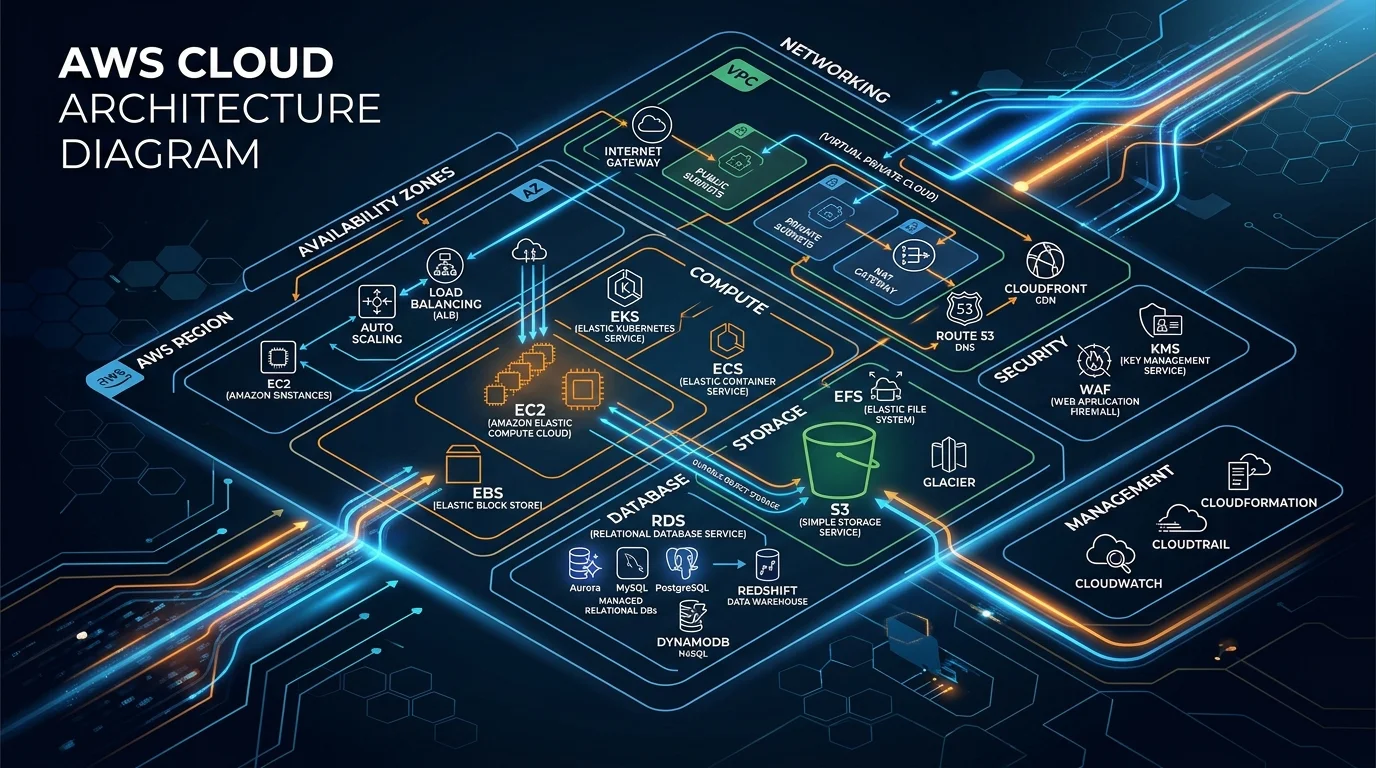
- Compute Services: Amazon EC2 (virtual servers in the cloud), AWS Lambda (serverless event-driven computing that executes code without provisioning servers), Amazon ECS and Amazon EKS (container orchestration), and AWS Elastic Beanstalk (Platform as a Service for rapid deployment).
- Storage Services: Amazon S3 (scalable object storage with tiered classes: Standard, Intelligent-Tiering, Glacier Flexible, Glacier Deep Archive), Amazon EBS (block storage volumes attached to EC2 instances), and Amazon EFS (managed network file system for shared access).
- Database Services: Amazon RDS (managed relational databases supporting PostgreSQL, MySQL, MariaDB, Oracle, SQL Server), Amazon Aurora (high-performance cloud-native relational engine), and Amazon DynamoDB (managed, sub-millisecond NoSQL document database).
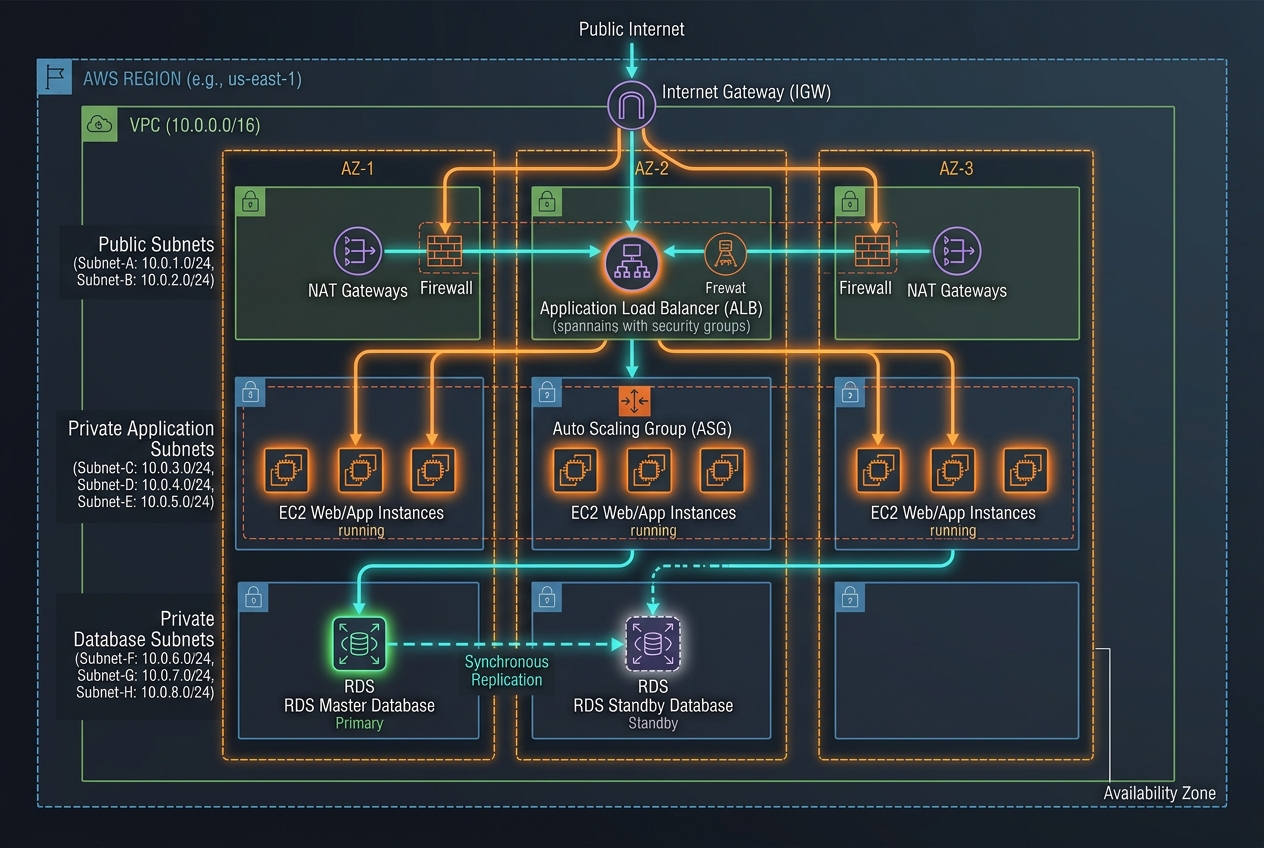
- Networking & Content Delivery: Amazon VPC (isolated virtual network), Subnets (public vs. private), Internet Gateways, NAT Gateways, Route 53 (DNS routing), and Amazon CloudFront (global Content Delivery Network).
Domain 4: Billing, Pricing, and Support (12% of Exam)
The final domain focuses on financial governance, cost optimization tools, and support contract tiers:
- AWS Pricing Models: On-Demand Instances (maximum flexibility, no upfront commitment), Reserved Instances (1 or 3-year commitment for predictable workloads up to 72% discount), Savings Plans (hourly spend commitment), and Spot Instances (spare capacity up to 90% discount for fault-tolerant workloads).
- Cost Tracking Tools: AWS Cost Explorer (visualize and forecast past and future spend), AWS Budgets (custom threshold alerts), and Cost Allocation Tags (categorize expenses by business department or project).
- AWS Support Plans: Basic (free customer service and documentation), Developer (business hours email support, general guidance < 24 hrs), Business (24/7 phone, email, chat support, production down < 1 hr), and Enterprise On-Ramp / Enterprise (15-minute response for business-critical outages, dedicated Technical Account Manager).
The 30-Day AWS Cloud Practitioner Study Plan
To pass comfortably within four weeks, commit 60 to 90 minutes each day following this structured, step-by-step aws cloud practitioner study guide curriculum:
Week 1: Cloud Concepts & Global Infrastructure (Days 1–7)
Begin by setting up a free-tier AWS account. Focus your initial week on high-level architecture:
- Day 1–2: Study cloud computing definitions, SaaS vs. PaaS vs. IaaS, and the Six Advantages of Cloud.
- Day 3–4: Master the AWS Global Infrastructure—understand AWS Regions (geographic clusters), Availability Zones (isolated data center facilities with low-latency connections), and Edge Locations (points of presence for CloudFront caching).
- Day 5–7: Review the AWS Well-Architected Framework. Take summary notes comparing Reliability versus Performance Efficiency. Practice identifying high availability versus disaster recovery architectures.
Week 2: Compute, Storage & Networking Fundamentals (Days 8–15)
Dive deep into hands-on core infrastructure services:
- Day 8–10: Launch a free micro EC2 Linux instance in the AWS Management Console. Connect via EC2 Instance Connect. Contrast EC2 instance billing with AWS Lambda serverless execution.
- Day 11–12: Create an Amazon S3 bucket. Upload objects, configure bucket versioning, and review lifecycle policies for transitioning data into Glacier Deep Archive. Compare S3 object storage with EBS block storage and EFS shared storage.
- Day 13–15: Understand Virtual Private Clouds (VPC). Learn how Security Groups act as stateful virtual firewalls at the instance level, while Network Access Control Lists (NACLs) operate as stateless firewalls at the subnet level.
Week 3: Security, IAM & Shared Responsibility (Days 16–22)
Focus intensively on Domain 2 to ensure maximum score retention:
- Day 16–18: Set up IAM Users, Groups, and Policies. Learn why the root account user credentials must be locked away after creating an administrative IAM user with MFA.
- Day 19–20: Memorize the Shared Responsibility Model matrix. Test yourself on specific scenarios: Who patches the guest operating system on EC2? (Customer). Who patches the underlying hypervisor on RDS? (AWS). Who encrypts S3 customer data at rest? (Customer configuration; AWS executes KMS).
- Day 21–22: Study AWS Shield Standard (included free) versus AWS Shield Advanced, AWS WAF, and AWS Secrets Manager. Review auditing compliance tools including AWS Artifact and AWS CloudTrail.
Week 4: Billing, Support Tiers & Full Practice Exams (Days 23–30)
Spend your final week simulating real exam conditions:
- Day 23–25: Memorize AWS Support plan response times and features. Create custom budget alerts in AWS Budgets. Learn how Consolidated Billing under AWS Organizations aggregates volume tier discounts across multiple accounts.
- Day 26–28: Take your first 65-question timed practice exam. Review every incorrect answer thoroughly. Focus on identifying distractors—options that describe real AWS services but solve the wrong architectural problem.
- Day 29–30: Take two full-length practice tests under exam conditions. Score at least 85% on both before scheduling your official test session at a Pearson VUE testing center or via online proctoring.
Common Exam Pitfalls & High-Yield Distinctions
The CLF-C02 exam frequently tests candidates on subtle differences between closely related AWS services. Keep these high-yield rules in mind:
| Service A | Service B | Key Differentiating Rule |
|---|---|---|
| AWS CloudTrail | Amazon CloudWatch | CloudTrail tracks who did what (API auditing and governance); CloudWatch tracks performance metrics and alarms (CPU, disk usage, billing alerts). |
| Security Group | Network ACL | Security Groups are stateful (return traffic automatically allowed) at instance level; NACLs are stateless (inbound and outbound rules required) at subnet level. |
| AWS Shield | AWS WAF | Shield mitigates Layer 3 & 4 DDoS flood attacks; WAF blocks Layer 7 malicious HTTP exploits (SQL injection, cross-site scripting). |
| Amazon S3 | Amazon EBS | S3 is serverless internet-accessible object storage; EBS is high-performance block storage mounted directly to a running EC2 instance. |
| AWS Organizations | AWS Control Tower | Organizations manages multi-account governance and consolidated billing; Control Tower automates landing zone provisioning and compliance guardrails. |
Recommended Free & Low-Cost Study Resources
You do not need to spend hundreds of dollars on commercial bootcamps to pass the Cloud Practitioner exam. Utilize these authoritative materials:
- AWS Skill Builder (Free): Amazon’s official AWS Cloud Practitioner Essentials digital course provides 6 hours of high-quality video modules directly from AWS curriculum engineers.
- Official Exam Guide (Free): Download the latest CLF-C02 Exam Guide PDF from official AWS Documentation to review every listed service in scope.
- Hands-on AWS Free Tier: Practice launching EC2 instances and creating S3 buckets inside your own free sandbox account. Hands-on muscle memory makes abstract questions intuitive.
- Interactive Career Strategy: If your broader career objective includes transitioning toward cloud data engineering or data analytics, examine our foundational Data Analyst vs Data Scientist vs Data Engineer comparison guide and explore portfolio building strategies with our Portfolio Project Generator.
- Compensation Benchmarking: Evaluate how AWS certifications impact median tech salaries across infrastructure and analytics disciplines using our Tech Career Salary & Bootcamp ROI Calculator.
Frequently Asked Questions (FAQ)
How long does it take to prepare for the AWS Cloud Practitioner exam?
Most candidates with zero prior cloud experience prepare effectively in 3 to 4 weeks by studying 1 to 1.5 hours daily. Candidates with basic IT, systems administration, or web development experience can pass with 10 to 15 hours of focused study over 1 to 2 weeks.
Is the AWS Certified Cloud Practitioner certification worth it in 2026?
Yes. While it is an entry-level certification, the CLF-C02 validates baseline cloud literacy recognized globally by employers. It serves as an essential foundation before tackling associate-level credentials like AWS Solutions Architect Associate (SAA-C03) or SysOps Administrator.
What is the passing score for the CLF-C02 exam?
The passing score is 700 on a scaled score range of 100 to 1,000. The exam consists of 65 questions, of which 50 contribute to your final score while 15 are unscored diagnostic questions used by AWS for future test calibration.
Can I take the AWS Cloud Practitioner exam online from home?
Yes. You can take the exam remotely via Pearson VUE online proctoring from your home or office, provided you have a reliable internet connection, a quiet room, and an approved webcam and microphone. You may also test in person at an authorized Pearson VUE testing center.
What happens if I fail the AWS Cloud Practitioner exam?
If you do not pass, AWS requires a 14-day waiting period before you can retake the exam. There is no limit to the number of retakes permitted within a calendar year, although each attempt requires paying the exam fee.