
Breaking into the high-paying data industry requires verified technical competence, and choosing the right program from a comprehensive data analytics certifications guide is the fastest way to validate your skills without spending tens of thousands of dollars on a master’s degree. In this unbiased guide, we evaluate the industry’s top five data analytics credentials—analyzing exact examination costs, curriculum depth, real-world employer prestige, and verified salary return on investment (ROI) to help you choose the ideal certification for your career path.
| Certification Title | Issuing Body | Total Cost | Study Commitment | Best Suited For |
|---|---|---|---|---|
| Google Data Analytics Professional | Google / Coursera | $39–$49 / mo | 3–6 months | Absolute beginners & non-technical career switchers |
| Microsoft PL-300: Power BI Analyst | Microsoft | $165 | 2–3 months | Business intelligence & enterprise dashboard specialists |
| AWS Certified Data Analytics | Amazon Web Services | $300 | 4–6 months | Cloud data engineers & warehouse architects |
| IBM Data Analyst Professional | IBM / Coursera | $39–$49 / mo | 3–5 months | Python-focused analysts seeking applied machine learning |
| CompTIA Data+ (DA0-001) | CompTIA | $358 | 2–4 months | Vendor-neutral data governance & compliance roles |
Do Data Analytics Certifications Really Get You Hired?
The tech recruitment landscape has shifted dramatically over the past two years. With automated applicant tracking systems (ATS) screening hundreds of resumes per job opening, verified credentials from recognized technology vendors provide an essential initial filter. According to employment data published by the U.S. Bureau of Labor Statistics, demand for data specialists is projected to surge by 35% through 2032, making data analytics one of the fastest-growing professional disciplines in the modern economy.
However, certifications alone will not secure a job offer. Hiring managers look for a powerful combination: a recognized credential that confirms baseline technical literacy, backed by a portfolio of end-to-end analytical projects proving real-world problem-solving ability. To calculate how different certifications and training paths impact your projected income, use our interactive Tech Salary & Bootcamp ROI Calculator, or design your multi-month learning roadmap with the Career Roadmap Planner.
Detailed Comparison: Top 5 Industry Credentials
Below is a visual comparison matrix outlining how the leading analytics credentials compare across examination formats, tools covered, and preparation difficulty.

Figure 1: Side-by-side comparison matrix of the leading industry certifications for data analysts.
1. Google Data Analytics Professional Certificate
Widely regarded as the premier entry point for beginners, Google’s program covers spreadsheet formulas, SQL data cleaning in BigQuery, data visualization in Tableau, and basic statistical analysis in R programming. Over 100,000 graduates have used this program to transition into tech.
- Pros: Zero prerequisite knowledge required; includes a complete hands-on capstone project; eligible for Google Career Certificates employer consortium.
- Cons: Focuses on R instead of the more widely demanded Python; portfolio projects tend to look uniform across candidates unless heavily customized.
- Verdict: The #1 recommendation for complete beginners needing structured, confidence-building fundamentals.
2. Microsoft Certified: Power BI Data Analyst Associate (Exam PL-300)
For analysts aiming for corporate finance, commercial operations, and enterprise business intelligence, Microsoft’s PL-300 is the gold standard. It tests real-world data preparation in Power Query, star schema data modeling, complex DAX calculations, and security administration.
- Pros: Highly valued by Fortune 500 enterprises running the Microsoft ecosystem; rigorously proctored multiple-choice exam carries substantial resume weight.
- Cons: Requires genuine hands-on experience with DAX and data modeling; passing without practical lab practice is exceptionally difficult.
- Verdict: The best career-accelerating credential for mid-level analysts wanting to master modern business intelligence.
3. AWS Certified Data Analytics – Specialty (DAS-C01)
For professionals managing large-scale cloud data pipelines, AWS offers deep specialization. The curriculum spans distributed streaming data with Amazon Kinesis, managed data warehouses with Amazon Redshift, and serverless queries using AWS Athena and Glue.
- Pros: Commands the highest average salary premiums in the cloud industry ($130,000+); validates architectural competence.
- Cons: Challenging exam requiring deep prior familiarity with distributed computing and cloud networking.
- Verdict: Ideal for senior analysts transitioning into data engineering and cloud architecture. Be sure to check our foundational AWS Cloud Practitioner Study Guide before attempting specialty-level exams.
4. IBM Data Analyst Professional Certificate
IBM’s program provides a compelling alternative to Google by substituting R with Python. Learners master data analysis using Pandas, NumPy, and Matplotlib, interact with relational databases using SQL, and build interactive dashboards using IBM Cognos Analytics.
- Pros: Strong emphasis on Python and real-world Jupyter notebook development; excellent preparation for machine learning.
- Cons: Cognos Analytics has smaller commercial market share compared to Microsoft Power BI and Tableau.
- Verdict: Best for candidates aiming for data science tracks who prioritize Python programming.
5. CompTIA Data+ (Exam DA0-001)
CompTIA Data+ takes a vendor-neutral approach to data literacy, focusing on data governance, statistical validity, reporting hygiene, and regulatory compliance (GDPR, HIPAA).
- Pros: Universally applicable across diverse industry sectors; strong foundation in statistical principles and ethical data governance.
- Cons: Higher exam cost ($358); lacks deep focus on modern coding frameworks like SQL and Python.
- Verdict: Recommended for compliance managers, healthcare administrators, and project leaders overseeing analytical teams.
Return on Investment (ROI) and Salary Progression
Certifications should always be viewed as financial investments. The infographic below traces the documented salary trajectory unlocked by stacking foundational and specialized credentials over a 3- to 5-year career arc.
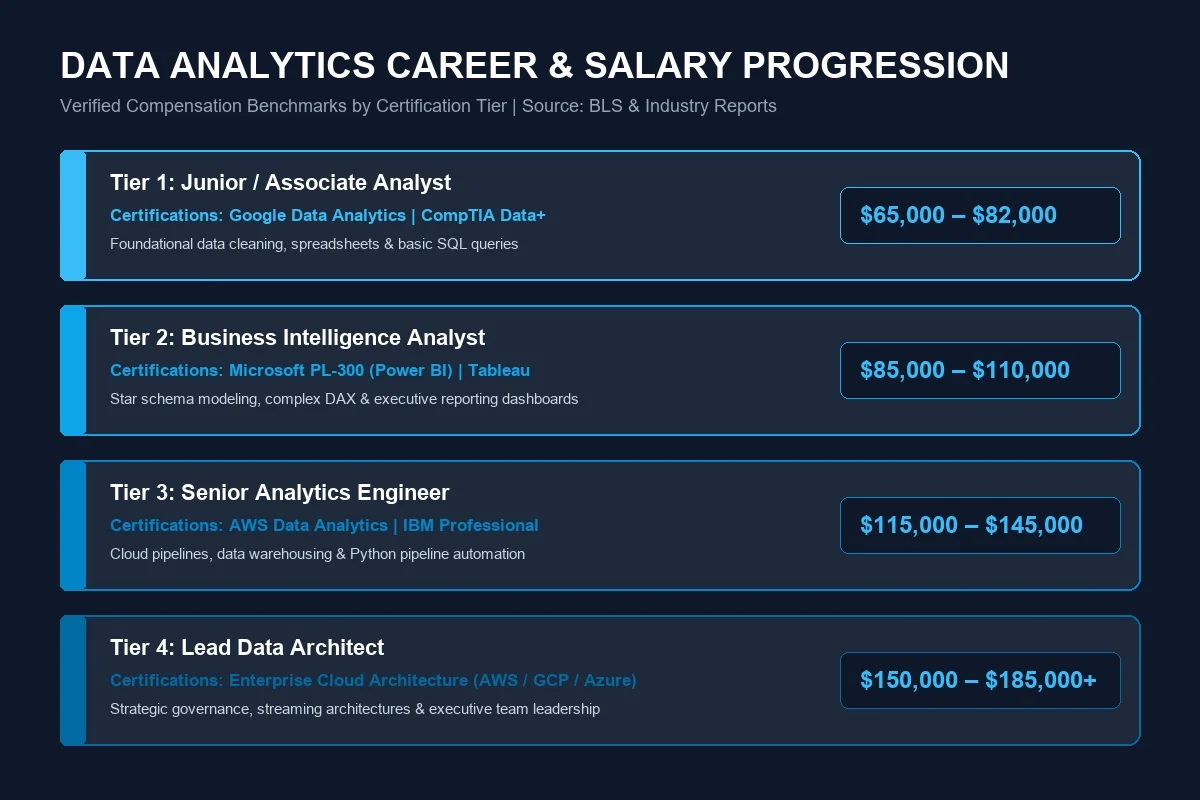
Figure 2: Average salary progression across data analytics career milestones and certification tiers.
Calculating Your Break-Even Timeline
Consider an entry-level professional investing $300 in study materials and a Microsoft PL-300 exam voucher. Upon obtaining the credential and transitioning from a non-technical customer support role ($45,000) to a Junior Business Intelligence Analyst role ($72,000), the first-year salary increase is $27,000—a staggering 9,000% return on investment within 12 months.
How to Pair Certifications with Portfolio Projects
To maximize recruiter response rates, never present a certificate in isolation. For each certification you complete, build a corresponding, public GitHub portfolio piece showcasing that exact tool stack. If you need fresh project blueprints using free open-source datasets, generate one instantly with our Portfolio Project Generator.
For practical guidance on structuring your repository, study our guides on 5 Data Analyst Portfolio Projects and the 30-Day SQL Roadmap. If you are preparing for technical screening rounds, review our SQL Interview Cheat Sheet to master the 20 most tested query patterns.
Frequently Asked Questions About Data Analytics Certifications
Step-by-Step Preparation Blueprint: How to Pass on Your First Attempt
Passing technical examinations like the Microsoft PL-300 or AWS Data Analytics requires disciplined preparation. Candidates who rely solely on passive video lectures experience a failure rate exceeding 40% on technical proctored assessments. To guarantee a first-time pass, follow this battle-tested 4-stage study framework:
Stage 1: Core Conceptual Foundations (Weeks 1 to 4)
Begin by mastering the theoretical data lifecycle: ingestion, transformation, storage, modeling, and visualization. Complete the official learning modules provided by vendor platforms (such as Microsoft Learn or AWS Skill Builder). Take detailed notes on technical definitions, specifically around database normal forms (1NF, 2NF, 3NF), dimensional modeling (star schema vs snowflake schema), and access governance.
Stage 2: Hands-On Laboratory Implementation (Weeks 5 to 8)
Technical certification exams do not just test memory; they test scenario-based problem solving. If you are preparing for the Microsoft PL-300 exam, you must build at least five complete end-to-end Power BI reports from scratch. Practice connecting to messy CSV and SQL data sources, performing advanced transformation steps in Power Query M-code, defining one-to-many single-direction relationships, and authoring time-intelligence DAX expressions like TOTALYTD, SAMEPERIODLASTYEAR, and CALCULATE with complex filter overrides.
Stage 3: Timed Practice Examination Sprints (Weeks 9 to 10)
In the two weeks leading up to your exam date, shift 80% of your daily study time to timed practice questions. Use reputable exam prep providers (such as MeasureUp for Microsoft exams or Tutorials Dojo for AWS credentials). Strive for a consistent score of 85% or higher on timed practice simulations before scheduling your official testing appointment. Carefully review every incorrect answer explanation to identify knowledge blind spots.
Stage 4: Exam Day Execution Strategy
Whether testing at a Pearson VUE physical testing center or online via remote proctoring, manage your examination clock strategically. Modern analytics exams typically comprise 40 to 65 questions across 100 to 180 minutes. Never spend more than 2.5 minutes on any single question. Flag ambiguous questions for review and complete all straightforward questions first. Remember that vendor exams do not penalize incorrect guesses, so ensure every question has a selected response before submitting.
Certification Maintenance, Renewals & Continuous Education
Earning your digital badge is only the beginning of your professional credentials journey. To maintain active certification status and preserve employer recognition, you must understand vendor renewal policies:
- Microsoft Role-Based Certifications (e.g., PL-300): Valid for one year from the issue date. Microsoft allows holders to renew their certification annually for free through an unproctored, open-book online assessment on Microsoft Learn, accessible 6 months prior to credential expiration.
- AWS Certifications (e.g., AWS Data Analytics / Machine Learning): Valid for three years. Recertification requires passing the current version of the examination or advancing to a higher-level specialty credential with a 50% discount voucher provided by AWS.
- CompTIA Certifications (e.g., Data+): Valid for three years. Holders can renew by earning 20 Continuing Education Units (CEUs) through industry webinars, professional publications, or approved tech training courses.
- Google Professional Certificates: These foundational credentials do not formally expire, but candidates are strongly encouraged to upgrade to intermediate vendor certifications after 12 to 18 months of real-world job experience.
Which data analytics certification is best for complete beginners?
The Google Data Analytics Professional Certificate on Coursera is universally recognized as the best starting point for beginners. It requires zero math or coding prerequisites and walks students systematically through spreadsheets, SQL, Tableau, and R programming.
Is Microsoft PL-300 or Tableau Certified Data Analyst better for jobs?
Both are highly respected, but Microsoft PL-300 (Power BI) currently leads in total corporate job postings due to Power BI’s seamless integration with Microsoft 365, Teams, and Azure ecosystems across enterprise companies.
How long does it take to prepare for a data analytics certification?
Foundational certificates like Google or IBM require 3 to 6 months of study dedicating 8 to 10 hours per week. Rigorous single-day proctored exams like Microsoft PL-300 or AWS Data Analytics typically take 2 to 4 months of dedicated practice.
Do employers verify certifications during background checks?
Yes. Legitimate tech employers verify credentials using Credly or vendor verification portals (such as Microsoft Learn and AWS Certification Registry). Always include your direct digital badge verification link on your LinkedIn profile and resume.
Can I get a data analyst job with only certifications and no degree?
Yes. Many tech and corporate employers have eliminated formal four-year degree requirements in favor of skills-based hiring. However, non-degree holders must showcase a standout GitHub portfolio featuring real business datasets and end-to-end analytical projects.