
While data scientists build predictive machine learning models and analysts design business dashboards, none of their work is possible without the robust infrastructure created by data engineers; following a structured data engineering roadmap for beginners is the fastest way to master this high-demand discipline without getting lost in an ocean of distributed computing frameworks. Data engineers design, build, and operationalize automated data pipelines that transform messy transactional logs into clean, reliable, analytical datasets. In this comprehensive roadmap, you will progress from programming fundamentals and data modeling to distributed computing with Apache Spark, pipeline orchestration with Airflow, and modern cloud data warehouses like Snowflake and BigQuery.
| Roadmap Milestone | Primary Focus Domain | Essential Tool Stack | Estimated Timeline |
|---|---|---|---|
| Phase 1: Programming & Data Foundations | Python OOP, advanced SQL, relational schema design | Python, PostgreSQL, Git, Docker | Weeks 1–4 |
| Phase 2: Data Warehousing & Modeling | Dimensional modeling, Star Schema, ELT transformations | Snowflake, BigQuery, dbt (data build tool) | Weeks 5–8 |
| Phase 3: Pipeline Orchestration | Directed Acyclic Graphs (DAGs), scheduling, retries | Apache Airflow, Prefect, Dagster | Weeks 9–12 |
| Phase 4: Distributed Big Data Processing | Memory partitioning, distributed transformations | Apache Spark, PySpark, Delta Lake | Weeks 13–16 |
| Phase 5: Real-Time Event Streaming | Pub/sub messaging, partition offsets, event-driven architectures | Apache Kafka, AWS Kinesis, Apache Flink | Weeks 17–20 |
What Is Data Engineering and Why Is Demand Surging?
Modern enterprises generate billions of raw data events every day across mobile applications, payment processors, customer support systems, and third-party APIs. However, raw data is notoriously fragmented, unindexed, and dirty. Data engineers construct automated extraction, transformation, and loading (ETL/ELT) systems that ensure business data is accurate, auditable, and delivered with sub-second query latency.
According to research published by the U.S. Bureau of Labor Statistics, database and data architecture engineering careers are projected to grow by 8% annually through 2032, with specialized data engineers commanding some of the highest salaries in tech ($125,000 to $180,000+ base). If you want to benchmark your earning potential, explore our interactive Tech Salary & Bootcamp ROI Calculator or map your long-term milestones with our Career Roadmap Planner.
The Modern Data Stack (MDS) Architecture
Over the past five years, the industry has shifted away from brittle legacy on-premises databases to the Modern Data Stack (MDS)—a modular, cloud-native ecosystem centered around decoupled compute and storage.
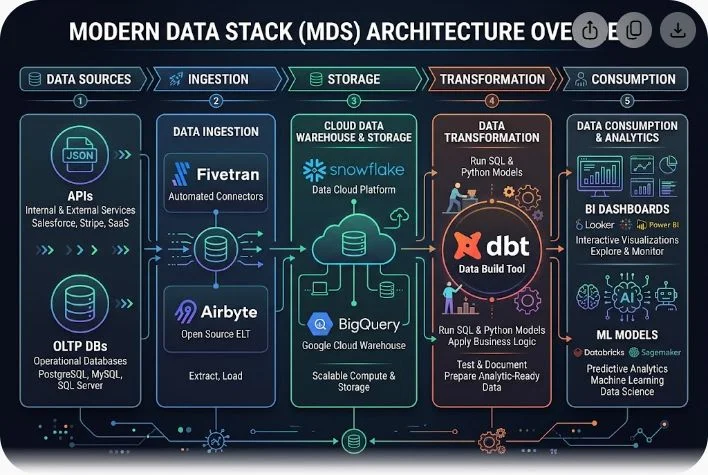
Figure 1: The five core layers of the Modern Data Stack (MDS) architecture.
The Five Layers of the Modern Data Ecosystem
- 1. Ingestion: Connectors (such as Airbyte and Fivetran) automatically replicate raw transactional data from production databases (PostgreSQL, MySQL) and SaaS APIs (Stripe, Salesforce) into the cloud data warehouse without custom extraction scripts.
- 2. Cloud Storage & Warehousing: Platforms like Snowflake, Google BigQuery, and Databricks store petabytes of structured and semi-structured (JSON) data with independent, elastic scaling of compute and storage.
- 3. Transformation (dbt): Data Build Tool (dbt) enables engineers to write modular SQL transformations version-controlled in Git, automatically handling dependency graphs, automated schema testing, and documentation generation.
- 4. Orchestration: Workflow schedulers like Apache Airflow manage complex pipeline execution orders, monitoring SLA deadlines and alerting engineers when upstream jobs fail.
- 5. Consumption & Reverse ETL: Downstream stakeholders query modeled data via BI dashboards (Power BI, Tableau) or sync customer segments back into operational CRMs via Reverse ETL tools like Census and Hightouch.
Phase 1: Advanced SQL & Data Modeling Mastery
SQL is the universal language of data. However, data engineers write SQL far differently than business analysts. In data engineering, query efficiency directly impacts cloud compute costs.
Essential SQL Concepts for Engineers
- Window Functions & Partitions: Mastering
DENSE_RANK(),LEAD(),LAG(), and moving aggregates. (Review our comprehensive SQL Interview Cheat Sheet for 20 common interview query patterns). - Dimensional Modeling (Kimball Methodology): Designing Fact tables (measuring numerical business metrics like orders and transactions) and Dimension tables (contextual attributes like customer profiles and product catalogs) in Star Schema or Snowflake Schema configurations.
- Slowly Changing Dimensions (SCD): Handling changing historical data using SCD Type 1 (overwrite), SCD Type 2 (track historical versions using effective start/end timestamps), and SCD Type 3 (store prior and current values).
Phase 2: Python for Data Engineering
Python is the undisputed standard programming language for data orchestration, custom API integrations, and distributed processing engines. Focus on production software engineering practices: Object-Oriented Programming (OOP), type hinting (pydantic), virtual environments, connection pooling, and writing unit tests with pytest.
Phase 3: Batch vs. Stream Processing Architecture
Enterprise data systems process data across two distinct paradigms: Batch Processing and Real-Time Stream Processing.
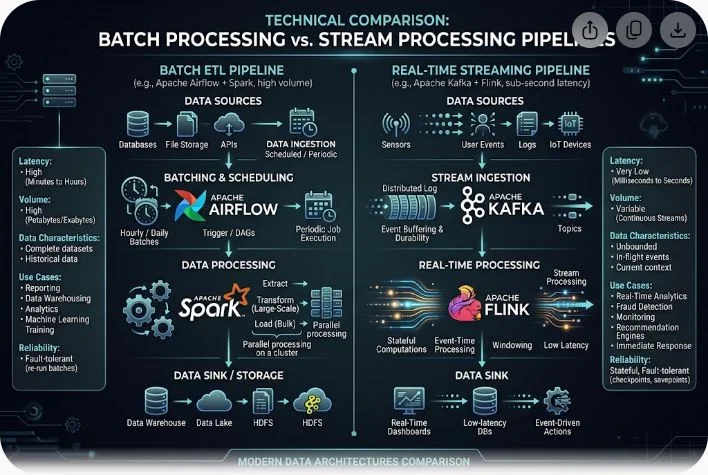
Figure 2: Architecture comparison between scheduled batch pipelines and event-driven streaming pipelines.
Batch Processing (Apache Spark & Airflow)
Batch processing collects data over a predefined time window (e.g., hourly, nightly) and processes it as a single chunk. Apache Spark is the gold-standard distributed computing framework for batch transformations, distributing memory operations across hundreds of worker nodes.
Stream Processing (Apache Kafka & Flink)
Stream processing handles data continuously as events occur with sub-second latency. Apache Kafka acts as a distributed commit log and event bus, decoupling real-time data producers (IoT sensors, credit card swipes) from downstream consumers (fraud detection algorithms, live analytics dashboards).
Phase 4: Cloud Infrastructure & DevOps for Data Engineers
Modern data pipelines are containerized and deployed to cloud infrastructure using automated CI/CD pipelines. Aspiring data engineers must understand Docker containerization, cloud networking, and Infrastructure as Code (IaC) with Terraform. For foundational cloud skills, review our AWS Cloud Practitioner Study Guide and our complete DevOps Roadmap for Beginners.
Phase 5: Building a High-Impact Data Engineering Portfolio
Data engineering hiring managers evaluate candidates by inspecting GitHub code repositories. A portfolio of toy Jupyter notebooks will not get you hired; you must build end-to-end automated pipelines that run in the cloud with real APIs. If you need fresh portfolio project ideas, use our free Portfolio Project Generator.
Three Production Projects Every Junior Engineer Needs
- Project 1: Automated End-to-End ELT Pipeline with dbt & Snowflake: Ingest daily crypto or financial market data from a public API using Python, load it into raw Snowflake tables, build modular transformation models in dbt with automated tests, and orchestrate the entire run using GitHub Actions or Airflow.
- Project 2: Distributed Data Processing with PySpark on AWS: Download a multi-gigabyte open dataset (such as NYC Taxi trips or Reddit comments), process the raw files using PySpark on AWS EMR or Databricks, optimize partition sizes, and write the curated data into partitioned Parquet/Delta Lake format in Amazon S3.
- Project 3: Real-Time Event Streaming Pipeline with Kafka: Build a simulated IoT device publisher streaming JSON events into an Apache Kafka topic, consume events using a Python or Spark Streaming script, perform windowed aggregations, and sink real-time alerts into a PostgreSQL database.
For candidates preparing for behavioral and managerial interviews, review our guide on Data Analyst Behavioral Interview Questions to master the STAR method, or explore enterprise planning workflows in our FP&A Analyst Career Guide.
Frequently Asked Questions About Data Engineering Roadmaps
Advanced Distributed Computing: PySpark & Data Optimization
As dataset volumes expand into terabytes and petabytes, single-node Python scripts running on pandas inevitably fail with out-of-memory (OOM) errors. Distributed computing engines like Apache Spark break large computational tasks across dozens of worker nodes. However, writing efficient PySpark code requires mastering distributed memory architecture and avoiding expensive data shuffles.
1. Broadcast Joins vs. Shuffle Hash Joins
In distributed processing, joining two large datasets forces worker nodes to exchange data over the physical network—an operation known as a shuffle that represents the primary performance bottleneck in big data pipelines. When joining a massive 100-million-row Fact table with a smaller 50,000-row Dimension table (such as a country or product catalog lookup), data engineers use a broadcast join:
from pyspark.sql.functions import broadcast

# Prevent network shuffle by broadcasting small dimension table to all worker executors
optimized_df = large_fact_df.join(broadcast(small_dim_df), on="product_id", how="inner")
By instructing Spark to broadcast the small table directly to the in-memory cache of every worker node, the join executes locally on each partition without sending a single byte of the massive fact table across the cluster network.
2. Handling Data Skew with Key Salting
Data skew occurs when an unbalanced partition key (such as 80% of transactions originating from a single enterprise client) causes one worker executor to process gigabytes of data while other nodes sit idle. Senior data engineers resolve this by “salting” the join key—appending a random integer (e.g., 0 to 9) to the skewed key on the fact table and replicating the matching dimension keys across all salt values, forcing Spark to distribute the workload evenly across cluster executors.
Real-Time Streaming Architecture with Apache Kafka
While batch pipelines run on scheduled intervals (such as nightly Airflow DAGs), modern fintech, ride-sharing, and security applications demand immediate event processing. Apache Kafka serves as the central nervous system for enterprise real-time event streaming.
Core Kafka Components
- Producers: Client applications that write serialized JSON or Apache Avro event records into Kafka topics.
- Brokers & Partitions: Kafka clusters distribute topic data across physical partitions on multiple broker servers, enabling horizontal write scalability and ordered consumer parallelism.
- Consumer Groups: Microservices that read events from assigned topic partitions at their own pace, committing partition offsets to ensure fault-tolerant recovery.
- Exactly-Once Semantics (EOS): By combining idempotent producers with transactional commit APIs, Kafka guarantees that financial transactions and payment events are processed exactly once without loss or duplicate records even during hardware server crashes.
FinOps: Managing Cloud Data Warehouse Costs
A poorly written SQL query in Snowflake or BigQuery can cost a company thousands of dollars in cloud compute credits in minutes. Modern data engineers act as financial stewards of cloud infrastructure:
- Clustering Keys & Partition Pruning: Partition BigQuery and Snowflake tables by transaction date or tenant ID so queries scan only relevant data blocks rather than entire petabyte tables.
- Auto-Suspend Policies: Configure Snowflake virtual warehouses to automatically suspend after 60 seconds of inactivity to eliminate idle compute billing.
- Incremental Materialization in dbt: Use
materialized='incremental'in dbt transformation models to process only net-new or updated records since the last pipeline run rather than rebuilding tables from scratch every night.
How long does it take to learn data engineering from scratch?
For candidates with prior programming or SQL experience, mastering core data engineering takes approximately 6 to 9 months of dedicated study (15 to 20 hours per week). Complete beginners starting from zero coding background typically require 9 to 12 months.
Is data engineering harder to break into than data analysis?
Yes. Data engineering requires a deeper foundation in computer science, distributed systems architecture, Linux internals, and software engineering best practices than traditional data analyst roles, which focus primarily on SQL, spreadsheets, and visualization tools.
Do I need to learn Scala or is Python enough for Spark?
Python (PySpark) is more than sufficient for 90% of data engineering jobs in the modern market. Scala is primarily required in legacy big-data systems or ultra-high-throughput streaming environments. Focus on mastering Python first.
What is the difference between an ETL pipeline and an ELT pipeline?
In traditional ETL (Extract, Transform, Load), data is transformed on an external server before being loaded into the database. In modern ELT (Extract, Load, Transform), raw data is loaded directly into a cloud data warehouse (Snowflake/BigQuery) first, and transformations are executed directly inside the warehouse using SQL via dbt.
Which cloud provider is best to learn for data engineering?
AWS currently leads in total enterprise job postings for data engineers (Amazon S3, EMR, Redshift, Glue, Kinesis), followed closely by Google Cloud Platform (BigQuery, Dataflow) and Microsoft Azure (Synapse, Databricks). Concepts learned on AWS transfer seamlessly across all major cloud providers.