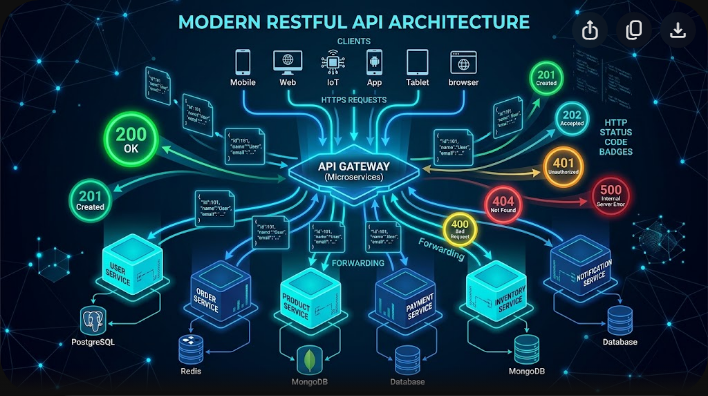
Application Programming Interfaces (APIs) form the connective tissue of the modern digital economy. Whether facilitating credit card transactions via Stripe, synchronizing mobile notifications through Firebase, or serving high-velocity data between cloud microservices, an organization’s APIs determine how easily developers can integrate, build, and scale software. However, despite the ubiquitous adoption of Representational State Transfer (REST) since Roy Fielding’s seminal 2000 doctoral dissertation, poorly architected APIs plague the industry with inconsistent URIs, improper HTTP verb usage, leaky database abstractions, and brittle error payloads.
A truly enterprise-grade RESTful API is intuitive, self-documenting, resilient to unexpected traffic spikes, and backwards-compatible across multi-year version horizons. In this definitive engineering handbook, we establish core architectural invariants: resource-oriented URI design, the critical distinction between Safe vs. Idempotent HTTP methods, robust cursor-based pagination, standardized RFC 7807 error handling, and high-performance token-bucket rate limiting. Assess your cloud deployment readiness with our AWS Cloud Practitioner Guide, or map your engineering trajectory using our Career Roadmap Planner.
| HTTP Method | Resource Action | Safe? | Idempotent? | Standard Success Code |
|---|---|---|---|---|
GET |
Retrieve a resource representation | Yes (Read-only) | Yes | 200 OK |
POST |
Create a new subordinate resource or execute an operation | No (Mutates state) | No | 201 Created |
PUT |
Completely replace a resource with a new representation | No | Yes | 200 OK / 204 No Content |
PATCH |
Apply partial delta modifications to an existing resource | No | No (Can be designed idempotent) | 200 OK |
DELETE |
Permanently remove a resource | No | Yes | 204 No Content |
Core Principle 1: Resource-Oriented URI Conventions
The foundational tenet of REST is that URIs represent nouns (resources), never verbs (actions). Actions are governed exclusively by HTTP methods. A common anti-pattern among inexperienced developers is embedding verbs into endpoint paths (e.g., /api/v1/getUserOrders or /api/v1/deleteCustomer). In a RESTful architecture, the resource is the entity, and the HTTP verb specifies the operational intent.
Golden Rules of URI Architecture
- Use Plural Nouns for Collections: Always name resource collections in the plural form (e.g.,
/api/v1/customersand/api/v1/orders) rather than singular nouns. This maintains semantic consistency when referencing individual items:/customers/123represents one entity from thecustomerscollection. - Represent Hierarchical Relationships via Nesting: When a child resource cannot exist independently of a parent, nest the child collection under the parent ID:
/api/v1/customers/{customer_id}/orders/{order_id}. Avoid nesting deeper than two levels to prevent bloated, unmanageable URL paths. - Kebab-Case for Multi-Word Paths: Separate multi-word resource names using hyphens rather than underscores or camelCase:
/api/v1/payment-methods, never/paymentMethodsor/payment_methods.
Core Principle 2: Safe vs. Idempotent HTTP Methods
Understanding the mathematical and operational definitions of Safety and Idempotency is mandatory for building resilient microservices that survive network timeouts and automated client retries.

1. Safe Operations
An HTTP method is considered Safe if invoking it produces zero observable side-effects on the server’s state. GET, HEAD, and OPTIONS are strictly safe. A client can execute 1,000 GET requests with absolute confidence that database records will not be altered or deleted.
2. Idempotent Operations
An operation is Idempotent if executing it multiple times produces the identical server state as executing it exactly once: f(f(x)) = f(x).
PUTis idempotent: Overwriting user 123’s email address with “dev@skillroadmaps.com” ten consecutive times leaves the record in the identical state as doing it once.DELETEis idempotent: Deleting resource 123 once removes it; repeating the command leaves the resource deleted (returning404 Not Foundor204 No Content), with zero additional state degradation.POSTis non-idempotent: Submitting an order payment viaPOST /api/v1/chargesfive times will charge the customer’s credit card five times unless protected by an Idempotency Key header (e.g.,Idempotency-Key: uuid-v4).
Core Principle 3: High-Performance Pagination Strategies
Returning an unconstrained array of 500,000 database rows in a single JSON response introduces severe memory consumption, database locks, and client-side rendering crashes. Enterprise APIs enforce mandatory pagination.
Offset vs. Cursor-Based Pagination
| Pagination Model | Query Pattern | Strengths | Vulnerabilities at Scale |
|---|---|---|---|
| Offset / Limit | ?limit=20&offset=100 |
Simple to implement; allows direct jumping to page $N$ | Slow on large offsets (OFFSET 1000000 scans 1M rows); prone to missing/duplicate rows on active writes |
| Cursor-Based (Keyset) | ?limit=20&cursor=dXNlcl85OTg= |
Constant-time $O(1)$ database execution via B-tree index; immune to pagination drift | Cannot jump directly to arbitrary page numbers; requires strictly ordered unique sorting keys |
For high-throughput feeds, event logs, and messaging streams, Cursor-Based Pagination is the undisputed industry standard. The cursor is typically an opaque, Base64-encoded representation of the last record’s creation timestamp and primary ID (e.g., WHERE (created_at, id) < (cursor_time, cursor_id) ORDER BY created_at DESC, id DESC LIMIT 20).
Core Principle 4: Rate Limiting & Denial-of-Service Defense
Without rate limiting, a single rogue script, buggy mobile app loop, or malicious bad actor can exhaust your database connection pool and bring entire production clusters to a halt.

The Token Bucket Algorithm
Modern API gateways (such as Kong, Cloudflare, or AWS API Gateway) and Redis-backed middleware implement the Token Bucket Algorithm. Each client key or IP address is assigned a virtual bucket holding a maximum capacity of tokens (e.g., 100 tokens). Every inbound API request consumes 1 token. Tokens refill at a steady, predefined rate (e.g., 10 tokens per second). When the bucket is empty, subsequent requests are immediately rejected with an HTTP 429 Too Many Requests status code.
Standard Throttling Response Headers
Well-engineered APIs return transparent telemetry headers so well-behaved clients can dynamically throttle their traffic:
HTTP/1.1 429 Too Many Requests
Content-Type: application/problem+json
Retry-After: 30
X-RateLimit-Limit: 100
X-RateLimit-Remaining: 0
X-RateLimit-Reset: 1774528900
Core Principle 5: Standardized Error Payloads (RFC 7807)
Never return generic error responses like {"error": "Something went wrong"} with a misleading 200 OK status code. Production APIs adhere to the RFC 7807 Problem Details for HTTP APIs specification:
{
  "type": "https://api.skillroadmaps.com/errors/insufficient-funds",
  "title": "Insufficient Account Balance",
  "status": 422,
  "detail": "Your current account balance of $42.50 is insufficient for transaction amount $100.00.",
  "instance": "/api/v1/accounts/acc_9921/transfers/tx_48210",
  "invalid_params": [
    {
      "name": "amount",
      "reason": "Exceeds available balance"
    }
  ],
  "timestamp": "2026-09-26T08:14:00Z"
}
To continue building scalable backend architectures, explore our in-depth guides on PostgreSQL vs MySQL for Analytics, our breakdown of Docker & Kubernetes for Beginners, and our Cloud Engineer vs DevOps Engineer Career Path.
API Security Architecture: OAuth 2.0, JWT & API Key Governance
Securing enterprise RESTful endpoints requires a defense-in-depth architecture that decouples authentication (verifying identity) from authorization (verifying permissions). Modern public APIs utilize OAuth 2.0 Authorization Framework with JSON Web Tokens (JWT) for stateless session verification.
Stateless JWT Validation and Token Rotation
When a client authenticates via POST /api/v1/auth/token, the server issues an asymmetric cryptographically signed Access Token (valid for 15 minutes) and a secure, HttpOnly Refresh Token stored in Redis. Downstream microservices validate the access token locally using the authorization server’s public key (via JWKS endpoint), verifying claims and scopes without making expensive database round-trips for every inbound request. Implementing automated refresh token rotation prevents replay attacks and ensures instantaneous revocation if an account is compromised.
API Observability: Distributed Tracing & OpenTelemetry Standards
In microservice ecosystems where a single user request cascades across 15 separate internal services, debugging latency spikes requires comprehensive distributed tracing. Modern API platforms integrate OpenTelemetry (OTel) to instrument HTTP request contexts. By propagating standard W3C Trace Context headers (such as traceparent and tracestate), Site Reliability Engineers (SREs) can visualize the complete latency waterfall across API gateways, service meshes, database queries, and third-party webhook integrations, identifying exactly which microservice caused a 504 Gateway Timeout.
Frequently Asked Questions (FAQ)
What is the difference between PUT and PATCH?
PUT replaces the entire target resource with the uploaded payload; omitted fields are typically nullified or reset to defaults. PATCH applies partial modifications, altering only the specific fields specified in the request while leaving all other resource attributes intact.
How should API versioning be implemented?
The industry standard is URI Path Versioning (e.g., /api/v1/users), as it is explicit, easily cached by CDNs, and instantly readable. Alternative approaches include Header Versioning (e.g., Accept: application/vnd.company.v1+json), which maintains clean URLs but complicates browser debugging.
What is an Idempotency Key and why is it used?
An Idempotency Key is a unique UUID generated by the client and sent in an HTTP header (e.g., Idempotency-Key: 7b9a...) for non-idempotent operations like payments. If a network timeout occurs, the client can safely retry the request; the server recognizes the key, skips duplicate execution, and returns the cached original result.
When should an API return 401 Unauthorized vs 403 Forbidden?
401 Unauthorized indicates that the request lacks valid authentication credentials (e.g., missing or expired JWT token). 403 Forbidden indicates that the caller is authenticated, but their user role or permission level does not grant access to the requested resource.