
When navigating data analyst vs data scientist vs data engineer in today’s technology landscape, professionals often face confusing job titles, overlapping skill requirements, and divergent career trajectories. The global data landscape is projected to exceed 180 zettabytes of information by the end of 2026. Within this explosion of cloud databases, real-time streaming infrastructure, and generative artificial intelligence, organizations face a critical operational mandate: transform messy raw inputs into measurable business value. To execute this mission, companies hire three primary archetypes of data professionals: Data Analysts, Data Scientists, and Data Engineers.
Yet for aspiring tech professionals, career switchers, and university graduates, the boundaries separating these three disciplines remain notoriously blurred. Job postings frequently interchange requirements, tech recruiters confuse tool sets, and bootcamp advertisements claim you can master all three in twelve weeks. The consequences of choosing the wrong path are severe: weeks wasted memorizing multivariable calculus when you really needed SQL, or months wrestling with machine learning hyperparameter tuning when your true passion lies in building high-throughput cloud pipelines.
This flagship cornerstone guide provides the definitive 2026 comparison between Data Analyst, Data Scientist, and Data Engineer. We dismantle the confusion by comparing core responsibilities, mathematical depth, coding complexity, enterprise tech stacks, compensation trajectories, and concrete transition pathways.
Data Analyst vs Data Scientist vs Data Engineer: Executive Comparison
| Dimension | Data Analyst | Data Scientist | Data Engineer |
|---|---|---|---|
| Primary Mission | Explain what happened and why using historical business data to drive operational decisions. | Predict what will happen and optimize outcomes using statistical modeling and machine learning. | Build the reliable infrastructure, pipelines, and warehouses that move and clean raw data at scale. |
| Core Technical Languages | SQL, Python (Pandas/Seaborn) or R, Microsoft Excel. | Python (Scikit-Learn, PyTorch), R, SQL, Julia. | Python, SQL, Scala, Java, Rust, Bash. |
| Primary Tools & Platforms | Power BI, Tableau, Looker, Excel, Snowflake, Metabase. | Jupyter Notebooks, MLflow, TensorFlow, Hugging Face, Databricks. | |
| Mathematical & Statistical Rigor | Foundational (descriptive statistics, distributions, hypothesis testing, A/B testing). | Advanced (linear algebra, multivariable calculus, probability theory, Bayesian statistics). | Practical (discrete mathematics, algorithmic complexity Big-O, data structures). |
| Software Engineering Rigor | Basic (scripts, queries, simple automation notebooks). | Intermediate (OOP, modular code, model deployment, API integration). | Advanced (distributed systems, CI/CD, concurrency, microservices, containerization). |
| Entry-Level Salary (US Average) | $72,000 – $85,000 / year | $95,000 – $115,000 / year | $90,000 – $110,000 / year |
| Senior-Level Salary (US Average) | $125,000 – $160,000 / year | $160,000 – $210,000+ / year | $155,000 – $205,000+ / year |
| Best Suited For | Business storytellers, investigative thinkers, and visual communicators. | Mathematical researchers, experimentalists, and algorithm designers. | Systems builders, architectural thinkers, and backend software tinkerers. |
Curious how these compensation bands translate across global currencies and how fast your educational investment breaks even? Use our free Tech Salary & Bootcamp ROI Calculator to calculate net income, tax brackets, and ROI milestones across all three disciplines.
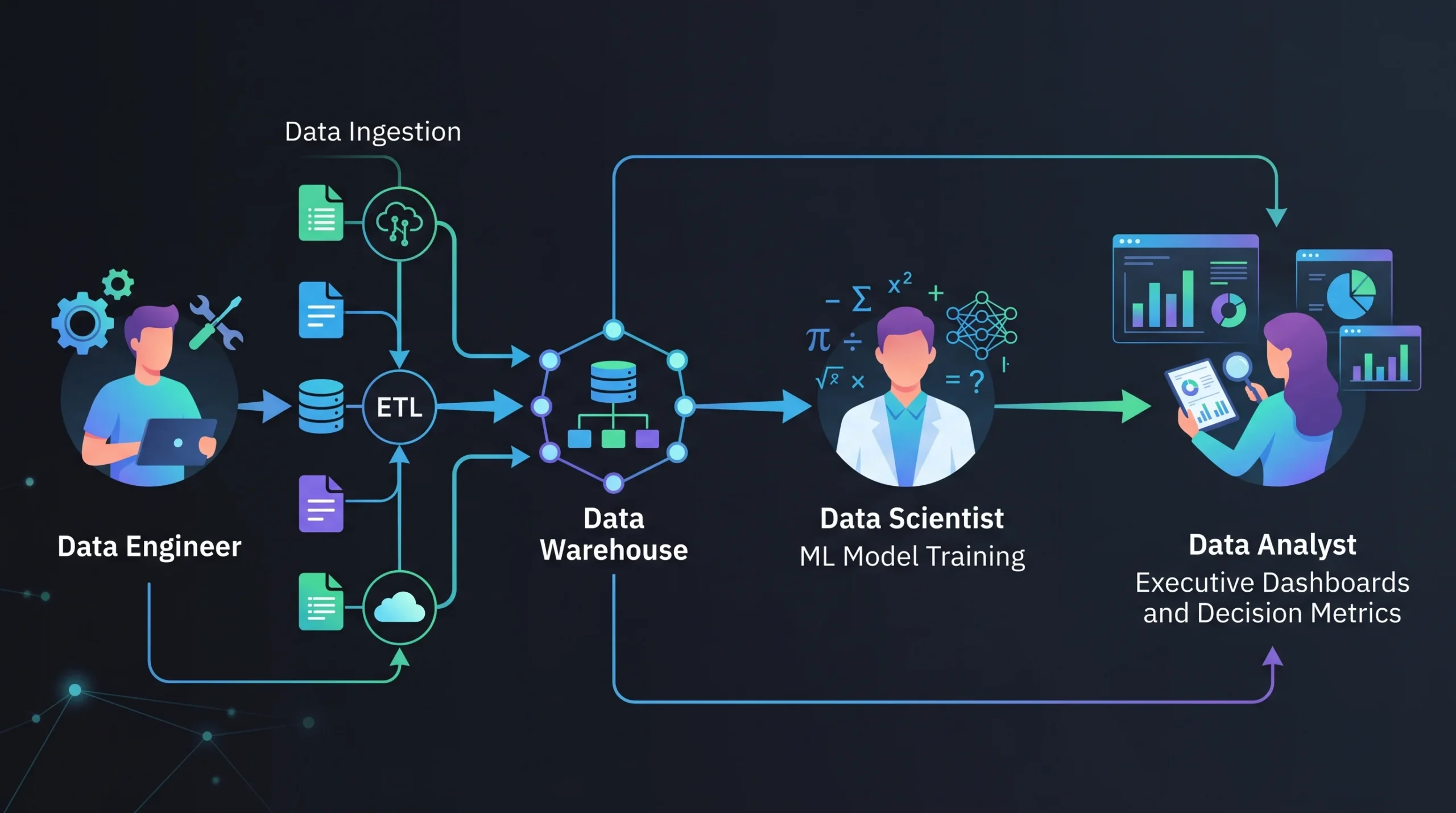
The Data Pipeline Lifecycle: How the Three Roles Collaborate
To truly understand how these three roles differ, consider a real-world enterprise scenario: predicting and preventing customer churn for an international streaming service with 50 million subscribers.
1. The Data Engineer Builds the Infrastructure
Understanding data analyst vs data scientist vs data engineer begins with data engineering, which constructs the automated ingestion pipelines and data warehouse architecture.
Before anyone can analyze or predict churn, someone must harvest the raw data. Every second, millions of users click titles, pause videos, browse categories, cancel payments, and stream shows on smartphones, smart TVs, and web browsers. This data is massive, unstructured, and distributed across hundreds of server endpoints.
The Data Engineer designs distributed ingestion pipelines using Apache Kafka and Apache Spark. They extract JSON telemetry logs, normalize user billing events, and load billions of records into a cloud data warehouse like Snowflake or Google BigQuery. They write automated transformation models in dbt, enforce database schema contracts, and guarantee that yesterday’s user engagement data is clean, indexed, and available by 6:00 AM every morning.
2. The Data Scientist Trains Predictive Algorithms
In the framework of data analyst vs data scientist vs data engineer, data scientists step in once cleaned data lands in the warehouse to train predictive models.
Once clean, structured data rests safely in the warehouse, the Data Scientist steps in. Their objective is not merely summarizing historical churn, but predicting which specific subscribers are likely to cancel their membership in the next 30 days.
The Data Scientist extracts historical behavioral features (e.g., number of logins per week, genre completion percentage, days since last video stream, billing error count). They split the data into training and testing cohorts, handle class imbalance using SMOTE, evaluate model architectures (Logistic Regression vs Random Forests vs XGBoost), tune hyperparameters, and track experiments in MLflow. Finally, they containerize the winning model into an automated inference API that scores every active user daily, outputting a churn probability percentage between 0.00 and 1.00.
3. The Data Analyst Translates Findings into Business Action
Completing the comparison of data analyst vs data scientist vs data engineer, analysts translate historical trends into visual executive dashboards.
A machine learning model predicting churn is useless if executives and marketing managers do not act upon it. This is where the Data Analyst creates commercial value.
The Data Analyst writes SQL queries combining the Data Scientist’s churn probability scores with historical marketing spend and customer lifetime value (LTV) cohorts. They design an interactive Power BI dashboard for the Chief Marketing Officer (CMO), demonstrating that users who watch fewer than 3 hours of content in their first 14 days exhibit an 80% higher churn rate. The analyst proposes a concrete commercial intervention: trigger an automated personalized email recommendation sequence on Day 7. Furthermore, the Data Analyst designs and monitors the A/B test verifying whether the email campaign delivered a statistically significant reduction in cancellations.
Without the Data Engineer, there is no data to work with. Without the Data Scientist, there are no predictive models. Without the Data Analyst, there is no actionable business decision. They are three sides of the same triangle.
Role 1 Deep Dive: The Data Analyst
Data Analysts are the commercial navigators of the enterprise. They sit closest to business stakeholders, product managers, marketing directors, and executive leadership.
Core Responsibilities
When analyzing data analyst vs data scientist vs data engineer, core daily duties diverge based on whether your focus is retrospective, predictive, or architectural.
- Exploratory Data Analysis (EDA): Digging into historical datasets to detect trends, anomalies, and correlations that explain business fluctuations.
- Dashboard Development & UX: Constructing automated, drill-down reporting portals in Power BI, Tableau, or Looker that eliminate manual reporting.
- Cross-Functional Storytelling: Presenting data insights to non-technical executives through clear visual narratives and structured recommendations.
- Experimentation & A/B Testing: Calculating statistical significance, sample sizes, and conversion uplifts for new feature launches.
The Essential Technical Toolkit
A central consideration in data analyst vs data scientist vs data engineer is the software stack required for daily execution.
- SQL (Advanced): Multi-table joins, subqueries, Common Table Expressions (CTEs), analytical window functions (
ROW_NUMBER,RANK,LEAD/LAG). Master this through our How to Learn SQL in 30 Days Study Plan. - Business Intelligence Platforms: Deep specialization in Power BI (DAX, Power Query) or Tableau. Review our head-to-head breakdown: Power BI vs Tableau: Which to Learn First?.
- Spreadsheet Modeling: Fluency in advanced Excel (XLOOKUP, INDEX/MATCH, dynamic arrays, Power Query). Review our guide: Excel for Data Analysis: The 7 Formulas You Actually Need.
- Python for Analytics: Scripting automated data extraction, cleaning messy text records, and generating statistical charts using Pandas and Seaborn. Review our Python for Data Analysis Roadmap.
Pros and Cons of the Data Analyst Path
Weighing data analyst vs data scientist vs data engineer involves assessing entry barriers and learning curves.
- Pros: Fastest barrier to entry (3 to 6 months); high job availability across every industry; direct visibility and communication with senior corporate leadership; remote-friendly flexibility.
- Cons: Lower initial starting compensation than engineering/data science; high risk of getting trapped doing manual ad-hoc spreadsheet reporting if you don’t build automated pipelines.
Role 2 Deep Dive: The Data Scientist
Data Scientists operate as mathematical researchers and applied machine learning engineers. They build mathematical representations of reality to automate complex decisions.
Core Responsibilities
- Statistical Modeling: Formulating mathematical hypotheses, estimating confidence intervals, and identifying true probabilistic drivers behind complex phenomena.
- Machine Learning Architecture: Selecting, training, and validating supervised algorithms (Linear/Logistic Regression, Decision Trees, Gradient Boosting) and unsupervised algorithms (K-Means, PCA, Hierarchical Clustering).
- Natural Language Processing (NLP) & Deep Learning: Fine-tuning transformers, building sentiment analysis engines, and structuring Large Language Model (LLM) workflows.
- Feature Engineering: Transforming raw variables into predictive signals (one-hot encoding, logarithmic transformations, interaction terms, vector embeddings).
- Model Validation & Drift Monitoring: Preventing overfitting, monitoring data drift, and ensuring model accuracy does not degrade over time in production.
The Essential Technical Toolkit
- Python & Scientific Computing: Python, NumPy, SciPy, Pandas.
- Machine Learning Libraries: Scikit-Learn, XGBoost, LightGBM, PyTorch, TensorFlow.
- Mathematics & Theory: Linear Algebra (matrix decomposition, eigenvalues), Multivariable Calculus (gradient descent optimization), Probability Distributions, and Inferential Statistics.
- Experimentation Tracking: MLflow, Weights & Biases, JupyterLab.
Pros and Cons of the Data Scientist Path
- Pros: Intellectually stimulating work at the bleeding edge of AI; prestigious career title; high compensation ceilings ($180k – $250k+ at senior levels).
- Cons: Steepest academic learning curve; high proportion of job openings require a Master’s degree or Ph.D. in STEM; high rate of failed enterprise projects where machine learning models never make it to production.
Role 3 Deep Dive: The Data Engineer
Data Engineers are backend software engineers who specialize in data plumbing, cloud architecture, and distributed computing. Without them, modern analytics and AI cannot function.
Core Responsibilities
- Pipeline Architecture (ETL/ELT): Building resilient, fault-tolerant batch and real-time streaming data ingestion pipelines from hundreds of enterprise sources.
- Data Warehouse & Lakehouse Design: Designing Kimball star-schema dimensional models, partitioning tables, optimizing clustering keys, and managing data lakes (Parquet, Delta Lake).
- Data Quality & Governance: Writing automated schema tests, validating data freshness SLAs (Service Level Agreements), and managing data lineage.
- Compute Optimization: Managing distributed computing clusters (Apache Spark, Databricks) and optimizing cloud compute costs to prevent runaway warehouse billing.
The Essential Technical Toolkit
- Programming Languages: Advanced Python, SQL, and frequently Scala, Java, or Rust.
- Cloud Data Warehouses: Snowflake, Google BigQuery, Amazon Redshift, Databricks.
- Data Transformation & Orchestration: dbt (Data Build Tool), Apache Airflow, Prefect, Dagster. Review our dedicated guide: The Complete Business Intelligence Developer Roadmap.
- Big Data & Streaming: Apache Spark, Apache Kafka, Apache Flink.
- Software Engineering Practices: Docker, Kubernetes, CI/CD pipelines (GitHub Actions), Terraform (Infrastructure as Code), Linux command line.
Pros and Cons of the Data Engineer Path
- Pros: Massive and enduring market demand (companies consistently report hiring 3 data engineers for every 1 data scientist); insulated from shifting AI trends; high compensation and clear U.S. Bureau of Labor Statistics (BLS) career ladders.
- Cons: Significant on-call responsibilities when production data pipelines break at 2:00 AM; requires deep software engineering foundations; minimal direct involvement in business strategy.
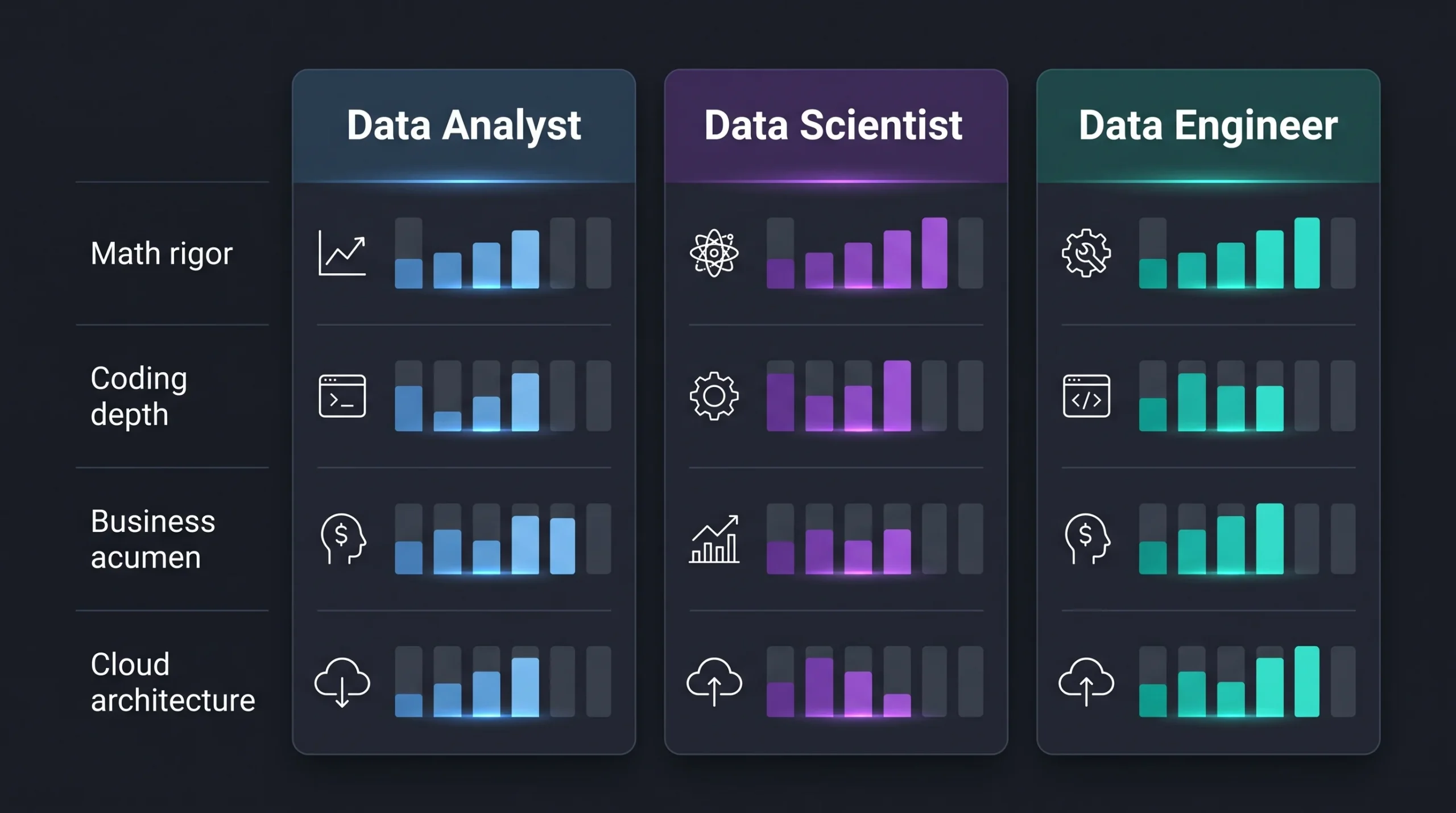
Data Analyst vs Data Scientist vs Data Engineer: Technical Skill Matrix
To evaluate which career matches your existing skillset, examine how competency requirements vary across the data spectrum:
| Skill Domain | Data Analyst | Data Scientist | Data Engineer |
|---|---|---|---|
| Relational SQL | ★★★★★ (Advanced Analytical Queries) | ★★★★☆ (Intermediate Extraction) | ★★★★★ (Expert DDL, DML & Optimization) |
| Python / R | ★★★☆☆ (Data Wrangling & EDA) | ★★★★★ (OOP, Modeling, Machine Learning) | ★★★★★ (Production Backend Code) |
| Mathematics & Statistics | ★★★☆☆ (Applied Business Stats) | ★★★★★ (Calculus, Linear Algebra, Probability) | ★★☆☆☆ (Discrete Math & Big-O) |
| Data Warehousing & Modeling | ★★★★☆ (Consuming Star Schemas) | ★★☆☆☆ (Consuming Prepared Features) | ★★★★★ (Architecting Kimball Models & Lakes) |
| Distributed Computing & Cloud | ★★☆☆☆ (Basic Cloud DW Access) | ★★★☆☆ (Cloud Model Training) | ★★★★★ (Spark, Kafka, Docker, Kubernetes) |
| Business Acumen & Stakeholder Comm | ★★★★★ (Executive Presentations & Storytelling) | ★★★☆☆ (Translating Research to Product) | ★★☆☆☆ (Internal Engineering Collaboration) |
Data Analyst vs Data Scientist vs Data Engineer: Salary & Earning Potential
Compensation across all three paths consistently ranks in the top 10% of global corporate careers. However, their compensation curves peak at different phases of experience.
1. Entry-Level (0 – 2 Years Experience)
- Data Analyst: $72,000 – $85,000 (US Average). Technical analysts with SQL and Python often start at $85,000 in tech hubs.
- Data Scientist: $95,000 – $115,000. Commands a higher starting floor due to the academic degree requirement.
- Data Engineer: $90,000 – $110,000. Compares directly to entry-level software engineering compensation.
2. Mid-Level (3 – 5 Years Experience)
- Data Analyst: $100,000 – $125,000, typically augmented by 10% annual performance bonuses.
- Data Scientist: $130,000 – $160,000, frequently supplemented by annual equity grants (RSUs).
- Data Engineer: $130,000 – $165,000, with high equity upside in venture-backed startups and cloud tech firms.
3. Senior & Principal Ceilings (6+ Years Experience)
- Data Analyst Path: Senior Analyst ($135k – $160k) → Analytics Manager ($165k – $195k) → Director of Analytics / VP of Business Intelligence ($200k – $260k+).
- Data Scientist Path: Senior Scientist ($165k – $210k) → Staff / Principal Data Scientist ($220k – $320k+) → Head of AI / Chief Scientist.
- Data Engineer Path: Senior Engineer ($160k – $205k) → Staff Data Engineer / Architect ($210k – $310k+) → VP of Data Engineering / Chief Technology Officer (CTO).
How to Transition Between Roles
Your first job in tech does not define your permanent career ceiling. Transitions across the data spectrum are common and highly rewarding:
From Data Analyst to Data Engineer
Many practitioners exploring data analyst vs data scientist vs data engineer start in analytics and transition toward data pipeline engineering.
This is currently the most popular transition in the industry. As analysts write complex SQL queries, they frequently realize they enjoy optimizing the database infrastructure more than building executive slide decks. To make the leap: learn Python object-oriented programming (OOP), master dbt (data build tool), learn Docker containerization, and study cloud data warehousing on Snowflake or BigQuery.
From Data Analyst to Data Scientist
Transitioning between roles in data analyst vs data scientist vs data engineer requires deepening statistical rigor and machine learning expertise.
If you love investigating causal relationships and predicting outcomes, transitioning into data science requires leveling up your mathematics. Focus on mastering linear regression mathematics, classification metrics (Precision, Recall, ROC-AUC), Scikit-Learn pipelines, and feature engineering techniques in Python.
Need portfolio inspiration to demonstrate your technical versatility to recruiters? Use our free Portfolio Project Generator to design projects tailored to your target transition role.
Data Analyst vs Data Scientist vs Data Engineer: Which Path Should You Choose?
To finalize your decision, reflect on which archetype resonates most naturally with your cognitive style and daily interests:
Choose Data Analyst if:
- You want the fastest, most pragmatic path to break into a high-paying tech career (within 3 to 6 months).
- You enjoy answering real-world commercial questions, solving organizational puzzles, and presenting visual stories to humans.
- You prefer mastering tools like SQL, Excel, and Power BI over studying calculus or managing cloud servers.
- You aspire to move toward Product Management, Business Strategy, or executive leadership.
Choose Data Scientist if:
- You have a strong quantitative background in math, statistics, physics, or economics, and enjoy academic problem-solving.
- You are genuinely fascinated by machine learning algorithms, probability distributions, predictive modeling, and AI research.
- You are willing to invest 1 to 2 years in rigorous technical preparation or pursue a graduate STEM degree.
- You want to work at the bleeding edge of automated decision-making and artificial intelligence.
Choose Data Engineer if:
- You think like a builder, mechanic, or architect: you care about speed, reliability, uptime, and scalable plumbing.
- You enjoy software engineering best practices: writing clean code, building CI/CD pipelines, containerizing apps, and working in the Linux terminal.
- You prefer technical engineering challenges over presenting slide decks to corporate marketing executives.
- You want high career stability and compensation that rivals top-tier backend software engineers.
To design your personalized, week-by-week learning blueprint tailored to your background and target career, use our interactive Career Roadmap Planner.
Frequently Asked Questions (FAQ)
1. In data analyst vs data scientist vs data engineer, which role is easiest for beginners?
Data Analyst is significantly the most accessible path for beginners. It does not require advanced software engineering foundations or higher-level calculus, and motivated learners can become job-ready within 3 to 6 months by mastering SQL, Excel, and Power BI.
2. In data analyst vs data scientist vs data engineer, which role earns the highest salary?
In 2026, compensation between senior Data Engineers and senior Data Scientists has reached virtual parity. While entry-level data scientists historically commanded slightly higher starting salaries due to academic degrees, experienced data engineers often command equal or higher salaries because reliable data infrastructure is universally required by every enterprise before any AI or modeling can occur.
3. Will Generative AI replace Data Analysts?
No. While AI tools (like Copilot and ChatGPT) accelerate routine SQL writing and basic chart generation, AI cannot validate whether dirty source data reflects operational reality, understand organizational politics, or persuade skeptical executives to change their commercial strategies. AI acts as a 5x productivity amplifier for skilled analysts rather than a replacement.
4. Do Data Scientists need a Master’s degree or Ph.D.?
Approximately 65% to 75% of formal Data Scientist job postings at top tech firms still require or prefer a Master’s degree or Ph.D. in a quantitative STEM field (Computer Science, Statistics, Mathematics, Physics). While self-taught candidates can break in through exceptional portfolios, the educational barrier remains substantially higher than for Data Analysts or Data Engineers.
5. Can I become a Data Engineer without a Computer Science degree?
Yes. Many high-performing Data Engineers began as Data Analysts or self-taught programmers. By building practical public pipelines using modern open-source tools (dbt, PostgreSQL, Docker, Apache Airflow, Snowflake), you can prove your technical competence directly to hiring managers.
6. When comparing data analyst vs data scientist vs data engineer, should I learn Python or SQL first?
Always learn SQL first. SQL is universally mandatory across all three disciplines: Data Analysts use it for business extraction, Data Scientists use it for feature collection, and Data Engineers use it for database architecture and dbt transformations. After mastering SQL, transition immediately to Python.
7. How does an Analytics Engineer fit into data analyst vs data scientist vs data engineer?
An Analytics Engineer is a modern hybrid role that bridges the gap between the Data Analyst and the Data Engineer. They use tools like dbt and SQL to transform clean data models inside the warehouse, enabling self-service analytics for business analysts without managing complex big-data infrastructure like Spark or Kafka.
8. How many portfolio projects do I need to get hired?
Quality completely outperforms quantity. Two to three deeply documented, end-to-end projects hosted on GitHub with clean code, clear README explanations, and interactive live dashboards will impress technical hiring panels substantially more than a dozen generic tutorials.
Published by the SkillRoadmaps Editorial Team | Updated for 2026 Industry Standards