
| Workflow Phase | Traditional Manual Method | GenAI-Augmented Analyst Workflow | Efficiency Gain | Primary Toolset |
|---|---|---|---|---|
| SQL Query Drafting | Handcrafting multi-table JOINs and window functions from memory | Describing business logic via context-rich prompts to generate baseline CTEs | 60% faster drafting | Claude 3.5 Sonnet / ChatGPT 4o |
| Data Cleaning & Regex | Writing complex nested regular expressions and string manipulations | Providing sample input/output strings to generate exact Python/SQL regex patterns | 75% faster transformation | GitHub Copilot / ChatGPT 4o |
| Exploratory Data Analysis | Writing repetitive summary statistics, distribution plots, and null checks | Automated EDA script generation, outlier detection scripts, and correlation profiling | 50% faster exploration | Python (Pandas, Seaborn) + AI Assistants |
| Executive Synthesis | Spending hours drafting narrative summaries and executive slide bullet points | Inputting structured KPI deltas to draft business-centric takeaways & root-cause hypotheses | 65% faster delivery | LLM Prompt Chaining |
| Code Debugging & Optimization | Manually scouring execution plans and query logs for index scans | Pasting execution plans to identify bottlenecks and rewrite subqueries to window functions | 55% faster resolution | AI Code Explainers |
Prompt Engineering for Data Analysts: The Modern AI Paradigm Shift
When navigating prompt engineering for data analysts in today’s technology landscape, professionals often face confusing job titles, overlapping skill requirements, and divergent career trajectories. The role of the data analyst has fundamentally changed. In earlier eras of enterprise intelligence, junior and mid-level analysts dedicated up to 80% of their weekly bandwidth to mechanical syntax retrieval: remembering complex SQL dialect nuances, looking up Pandas documentation for index resetting, and manually typing out repetitive business case statements. Today, modern Large Language Models (LLMs) have commoditized raw syntax generation. According to official workforce metrics from the Anthropic Interactive Prompt Engineering Guide, analytical and data engineering roles continue to experience rapid enterprise demand.
However, contrary to early predictions that artificial intelligence would replace data professionals, the demand for rigorous, analytical thinkers has never been higher. What companies need in 2026 is not someone who merely types code, but an analytical architect who understands business context, guarantees data integrity, validates machine outputs, and leverages generative AI to multiply their output by a factor of ten. Mastering prompt engineering is the single highest-leverage career upgrade an analyst can make.
Whether you are evaluating your skills against our interactive Career Roadmap Planner or comparing role definitions in our guide on Data Analyst vs Data Scientist vs Data Engineer, understanding how to communicate effectively with AI systems is now a core technical competency alongside SQL, Python, and BI dashboards.
The Anatomy of a High-Precision Analytics Prompt: The C-R-I-S-P Framework
Casual users treat AI assistants like search engines, entering vague queries such as “write a SQL query to calculate customer churn.” The resulting code is frequently unusable because the LLM lacks the schema structure, business definitions, and operational constraints required for enterprise data warehouses.
To produce production-grade analytical scripts on the first iteration, elite analysts follow the C-R-I-S-P Prompt Engineering Framework: Context, Role, Input Data & Schema, Specific Task, and Precision Constraints.
1. Context (The Business Problem & Warehouse Engine)
Never request code without specifying your underlying database engine (e.g., PostgreSQL 15, Snowflake, Google BigQuery, Databricks Spark SQL). SQL dialects differ dramatically in date arithmetic, string manipulation, and window function support. Furthermore, define why this query matters to the business.
2. Role (Persona Anchoring)
Persona anchoring is a high-leverage technique in prompt engineering for data analysts that primes LLMs to generate production-ready code.
Instruct the model to act as a specialized practitioner: “Act as a Lead Data Architect specializing in Snowflake cost optimization and enterprise retention metrics.” This primes the neural network to prioritize scalable, readable, and performant patterns over naive solutions.
3. Input Data & Schema Definition (The DDL Contract)
Always provide minimal Data Definition Language (DDL) snippets, sample column names, and real data types. Specifying whether a timestamp includes timezone offsets or whether an identifier is stored as an integer or string prevents 90% of model hallucinations.
4. Specific Task (Step-by-Step Logic)
Breaking analytical transformations into procedural steps is central to effective prompt engineering for data analysts.
Break complex analytical transformations into modular procedural requirements: compute monthly active users, calculate rolling 30-day cohorts, apply exclusion filters for employee test accounts, and format outputs with percentage formatting.
5. Precision Constraints (Guardrails & Formatting)
Explicitly instruct the model on what to avoid: “Use Common Table Expressions (CTEs) rather than nested subqueries. Do NOT use SELECT *. Include detailed inline comments explaining the denominator calculation. Return ONLY the code block without conversational filler.”
| C-R-I-S-P Pillar | Poor Prompting Practice | Elite Analytical Prompt Execution |
|---|---|---|
| Context | “Write a query for revenue” | “Target Database: Google BigQuery. Business Goal: Quarterly ARR calculation excluding refunds.” |
| Role | “Help me with SQL” | “Act as a Senior Analytics Engineer optimizing queries for petabyte-scale data lakes.” |
| Input Schema | “I have an orders table and customers table” | “Table `orders` (order_id INT, customer_id INT, amount NUMERIC, created_at TIMESTAMP).” |
| Specific Task | “Show top customers” | “Calculate 12-month rolling spend per customer cohort, grouped by signup channel.” |
| Constraints | None specified | “No Cartesian joins. Use QUALIFY with ROW_NUMBER() over subqueries. Add index suggestions.” |
Mastering SQL Generation & Query Optimization with LLMs
SQL generation is the most common use case for GenAI in analytics, yet poorly formed queries can accidentally lock database tables or rack up tens of thousands of dollars in cloud query scanning costs. Here is how modern practitioners deploy prompt engineering across the full query development lifecycle.
Use Case 1: Complex Window Functions and Cohort Retention
Mastering prompt engineering for data analysts allows you to generate multi-step retention matrices in minutes rather than hours.
Writing multi-step retention matrices manually requires intense focus on offset logic, lag calculations, and partitioning. When prompting an LLM for cohort retention, feed it the exact date truncation mechanics you wish to employ.
### PROMPT TEMPLATE: Cohort Retention SQL Engine
Role: Senior Analytics Engineer
Engine: PostgreSQL 16
Context: We need to evaluate user retention for our subscription SaaS platform.

Schema:
- subscriptions (
    user_id UUID,
    start_date DATE,
    end_date DATE,
    status VARCHAR(20) -- 'active', 'cancelled', 'paused'
  )

Task:
1. Generate a Monthly Cohort Retention Matrix spanning the last 12 calendar months.
2. Group users into cohorts based on their initial `start_date` truncated to month (Cohort Month).
3. Calculate retention rates across Month 0 through Month 11.
4. Output columns: cohort_month, cohort_size, m0, m1, m2, ..., m11 (as retention percentages formatted to 1 decimal place).

Formatting & Performance Constraints:
- Use modular Common Table Expressions (CTEs) named `user_cohorts`, `monthly_activity`, and `retention_pivot`.
- Ensure division-by-zero handling with NULLIF().
- Provide clean, readable ANSI-compliant SQL.
By defining CTE naming conventions and division-by-zero handling upfront, you eliminate post-generation debugging cycles. If you want to refine your core SQL foundations before utilizing automated workflows, review our dedicated guide on How to Learn SQL in 30 Days.
Use Case 2: Query Refactoring & Cost Optimization
When inherited queries run slowly or consume excessive compute credits on platforms like Snowflake or BigQuery, you can use prompt engineering to diagnose performance bottlenecks. Paste the query along with its database execution plan and prompt the AI to rewrite it.
### PROMPT TEMPLATE: SQL Query Optimization
Role: Database Performance Specialist
Engine: Snowflake Enterprise Warehouse
Problem: The following query takes 14 minutes to run and triggers memory spilling to remote storage.

Target Query:
[PASTE QUERY HERE]

Execution Plan Insights:
- Operator #4 (Cartesian Join) causes a 50x data explosion before filtering.
- Heavy sorting on an unindexed timestamp column.

Task:
1. Identify specific bottlenecks causing remote disk spill.
2. Rewrite the query utilizing CTEs, early partition pruning, and window functions to eliminate unnecessary full table scans.
3. Add explanatory inline comments on the architectural modifications made.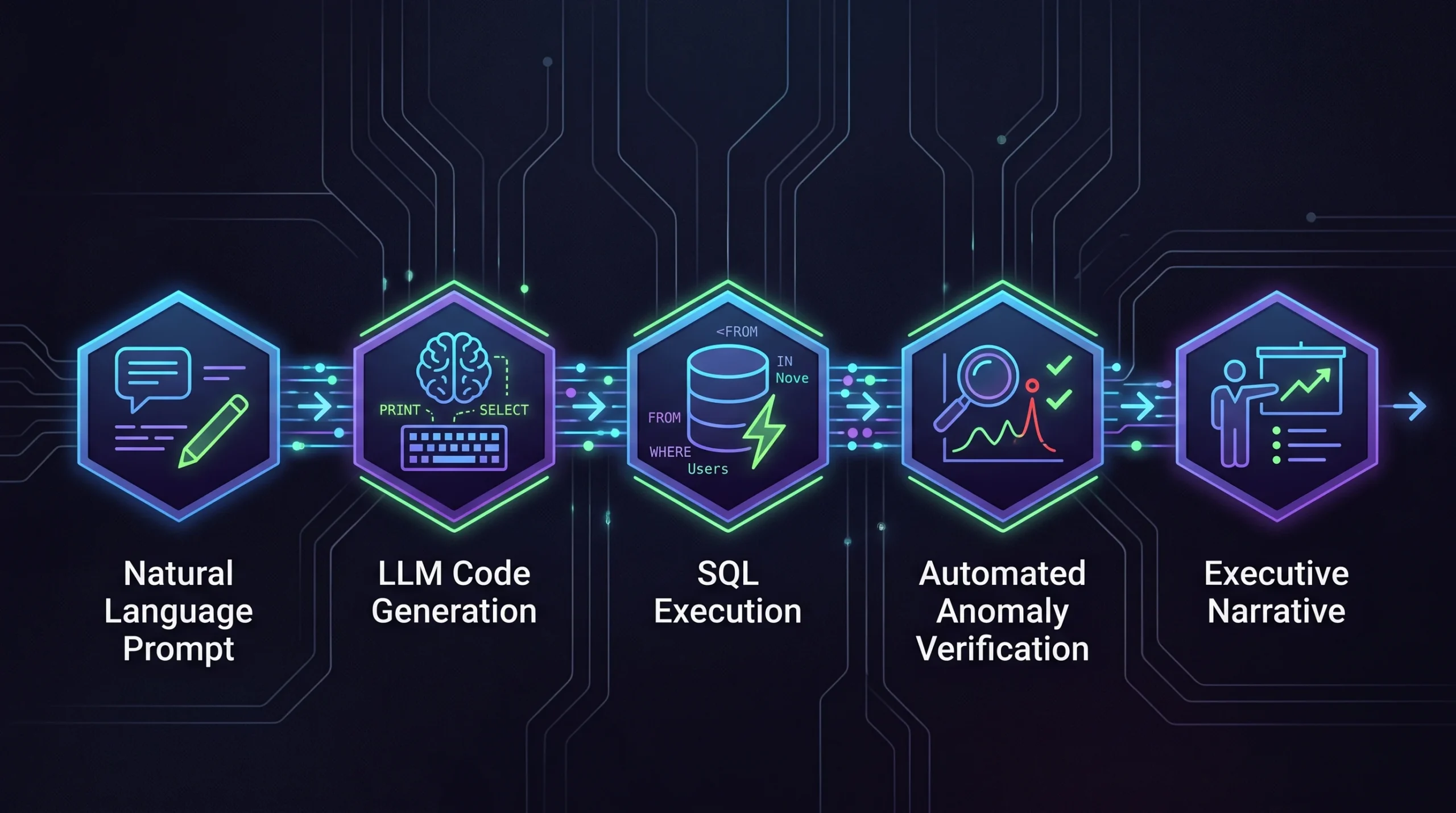
Prompt Engineering for Data Analysts: Automating Python Cleaning, Regex & EDA
Data wrangling in Python often involves deciphering cryptic regex syntax, parsing inconsistent ISO datetime formats, and imputing missing values. AI prompt engineering transforms hours of frustrating data cleaning into seconds of validation and execution.
Generating Bulletproof Regular Expressions
Applying few-shot prompt engineering for data analysts automates messy text parsing and regex pattern generation without trial and error.
Constructing regex for messy real-world strings—such as scraping unstructured customer feedback, extracting invoice numbers, or normalizing foreign phone numbers—is notoriously error-prone. The optimal prompt pattern is Few-Shot Learning with Extreme Edge Cases.
### PROMPT TEMPLATE: Few-Shot Regex Generation
Task: Create a Python function using the `re` library to extract standardized Transaction IDs from messy customer comments.

Positive Test Cases (Must Match):
- "Payment for invoice TXN-2026-98124 completed" -> "TXN-2026-98124"
- "ref: txn-2025-00129 via PayPal" -> "TXN-2025-00129"
- "Order # TXN-2026-11002" -> "TXN-2026-11002"

Negative Test Cases (Must NOT Match):
- "User ID: USER-2026-98124" (Wrong prefix)
- "TXN-26-9812" (Invalid year format, must be 4 digits)
- "TXN-2026-ABC" (Suffix must be 5 numeric digits)

Output Requirement:
Return a fully commented Python function `extract_transaction_id(text: str) -> Optional[str]` with doctests validating all test cases.
Automating Exploratory Data Analysis (EDA)
Using prompt engineering for data analysts to generate boilerplate EDA scripts frees up time for strategic business insights.
Instead of manually writing scripts to compute skewness, kurtosis, missing value distributions, and correlation matrices, analysts can feed column metadata into an LLM to generate a customized, enterprise-ready Python EDA script.
For structured guidance on which Python packages are worth mastering in conjunction with AI assistants, check out our comprehensive Business Intelligence & Analytics Tech Stack Roadmap.
Prompt Engineering for Data Analysts: Advanced Prompt Chaining for Executive Deliverables
Single prompts are effective for isolated tasks, but enterprise analytics workflows require Prompt Chaining: passing the output of one model invocation as the input to a subsequent prompt with a distinct objective.
Step 1: The Statistical Analysis Prompt
Prompt chaining expands prompt engineering for data analysts by feeding statistical variance outputs directly into root-cause synthesis prompts.
Input raw aggregated metrics into the LLM and instruct it to identify anomalies, standard deviation shifts, and trend reversals without conversational commentary.
Step 2: The Root-Cause Hypothesis Generator
Feed the detected anomalies into a business-context prompt that models potential industry drivers: marketing campaign pauses, seasonal holidays, technical downtime, or competitor pricing shifts.
Step 3: The Executive C-Suite Brief
Transform the analytical findings into executive-ready bullet points tailored to the VP of Finance or Chief Marketing Officer. The prompt instructs the model to lead with the bottom-line financial impact, followed by risk factors and recommended operational next steps.
| Prompt Chain Stage | Input Data / Artifact | AI Operation | Downstream Deliverable |
|---|---|---|---|
| Stage 1: Calculation | Cleaned CSV summary of weekly conversions | Identifies statistical variance > 2 sigma | Structured JSON of metric anomalies |
| Stage 2: Contextualization | JSON anomalies + Product release calendar | Correlates anomalies with feature releases | Causal relationship hypotheses table |
| Stage 3: Synthesis | Causal hypotheses + Revenue baseline | Drafts executive memo using Minto Pyramid | 3-bullet C-Suite Slack / Email briefing |
The Golden Rules of AI Verification & Data Privacy in Enterprise Analytics
While generative AI accelerates delivery, careless usage can introduce severe security breaches, copyright violations, and erroneous business decisions. Every professional analyst must adhere to strict enterprise protocols.
Rule 1: Never Upload PII or Unaggregated Financial Records
Data privacy and compliance are foundational boundaries when executing prompt engineering for data analysts on enterprise projects.
Never input Personally Identifiable Information (names, Social Security numbers, email addresses, credit card hashes) or proprietary unreleased financial data into public LLM web interfaces. Always sanitize inputs, use synthetic placeholder data, or utilize internal zero-data-retention enterprise API endpoints configured by your IT department.
Rule 2: The Trust-But-Verify Execution Sandbox
Never execute AI-generated code directly against production transactional databases. Always validate queries against lower-cost development environments, evaluate query execution plans (`EXPLAIN ANALYZE`), and spot-check row counts against verified benchmark dashboards.
Rule 3: Guard Against Silent Hallucinations
LLMs excel at syntax but struggle with implicit domain logic. If a model generates a calculation for Gross Margin, verify whether it subtracted Cost of Goods Sold (COGS) or inadvertently included operating expenses. The analyst remains 100% accountable for the integrity of every number delivered to stakeholders.
If you are planning your professional development budget for AI and analytics tooling, explore our Tech Salary & Bootcamp ROI Calculator to calculate the financial return of mastering high-demand skills.
Prompt Engineering for Data Analysts: Building Your AI-Augmented Portfolio
Recruiters in 2026 are actively screening for candidates who understand how to apply AI responsibly. An impressive portfolio no longer consists of simple exploratory notebooks copied from Kaggle; it highlights end-to-end analytical pipelines enhanced by automated prompt workflows.
Consider structuring portfolio projects that demonstrate:
- Automated Natural Language to SQL Dashboards: Building lightweight Streamlit or Chainlit interfaces where business users can ask questions and receive validated queries generated via vetted schema prompts.
- LLM-Powered Unstructured Feedback Sentiment Analyzers: Pipelines that extract customer themes, categorize bugs, and join qualitative sentiment scores with quantitative product usage metrics in Snowflake or PostgreSQL.
- Executive Briefing Bots: Automated Python scripts that pull daily KPI changes from a database and output Slack briefings summarizing performance drivers for department leaders.
Generate tailored, recruiter-approved project concepts using our Portfolio Project Generator to showcase your AI-augmented technical expertise.
| Portfolio Project Concept | Key Technologies | Demonstrated Competency | Target Roles |
|---|---|---|---|
| AI-Powered Retail BI Copilot | Python, Streamlit, DuckDB, Claude API | Natural language query parsing, schema injection, automated charting | BI Developer, Analytics Engineer |
| Automated Support Ticket Classifier | Python, Pandas, OpenAI API, PostgreSQL | Unstructured text embedding, sentiment classification, cohort churn analysis | Product Data Analyst |
| Algorithmic Marketing Attribution Engine | SQL, BigQuery, Few-Shot Prompting, Looker | Multi-touch attribution modeling, GenAI executive synthesis reports | Marketing Data Analyst, Growth Analyst |
Prompt Engineering for Data Analysts: Frequently Asked Questions
Will Prompt Engineering and Generative AI Replace Data Analysts?
No. Generative AI automates repetitive syntax generation and boilerplate code drafting, but it cannot interview business stakeholders, determine which metrics actually matter to company strategy, or guarantee data integrity across messy enterprise systems. Analysts who master prompt engineering become substantially more productive and valuable, replacing those who resist modern AI workflows.
What Is the Best AI Model for Writing SQL Queries in 2026?
Anthropic’s Claude 3.5 Sonnet and OpenAI’s GPT-4o are widely considered the gold standards for writing complex SQL, window functions, and database query optimization due to their superior logical reasoning, large context windows, and adherence to strict architectural constraints.
How Do I Prevent AI from Hallucinating Inaccurate SQL Metrics?
To eliminate hallucinations, always provide explicit schema definitions (DDL with column names and data types), define the exact SQL dialect, provide concrete examples of the expected calculation logic, and specify constraints such as avoiding Cartesian joins and handling division-by-zero errors.
Is It Safe to Use ChatGPT or Claude with Company Data?
Only if your organization utilizes enterprise licenses with zero-data-retention agreements and opt-outs for model training. Never paste customer Personally Identifiable Information (PII) or proprietary raw transactional data into public, consumer-tier AI chatbots. Always sanitize data and use schema structures or synthetic data when querying public models.
What Are the Essential Prompt Engineering Techniques for Analytics?
The core techniques include Role Prompting (assigning an expert persona), Few-Shot Prompting (providing input/output examples), Schema Injection (providing exact table structures), Chain-of-Thought Prompting (instructing the model to break calculations into logical steps), and Output Formatting Constraints (demanding pure code or structured JSON).
How Can I Showcase AI and Prompt Engineering Skills on My Resume?
Highlight specific efficiency and business impact metrics. Rather than simply listing ‘ChatGPT’ as a skill, write bullet points such as: ‘Engineered reusable LLM prompt templates and automated SQL query generation workflows, reducing weekly ad-hoc reporting turnaround time by 45% while maintaining 100% data reconciliation accuracy.’
Published by the SkillRoadmaps Editorial Team | Updated for 2026 Industry Standards