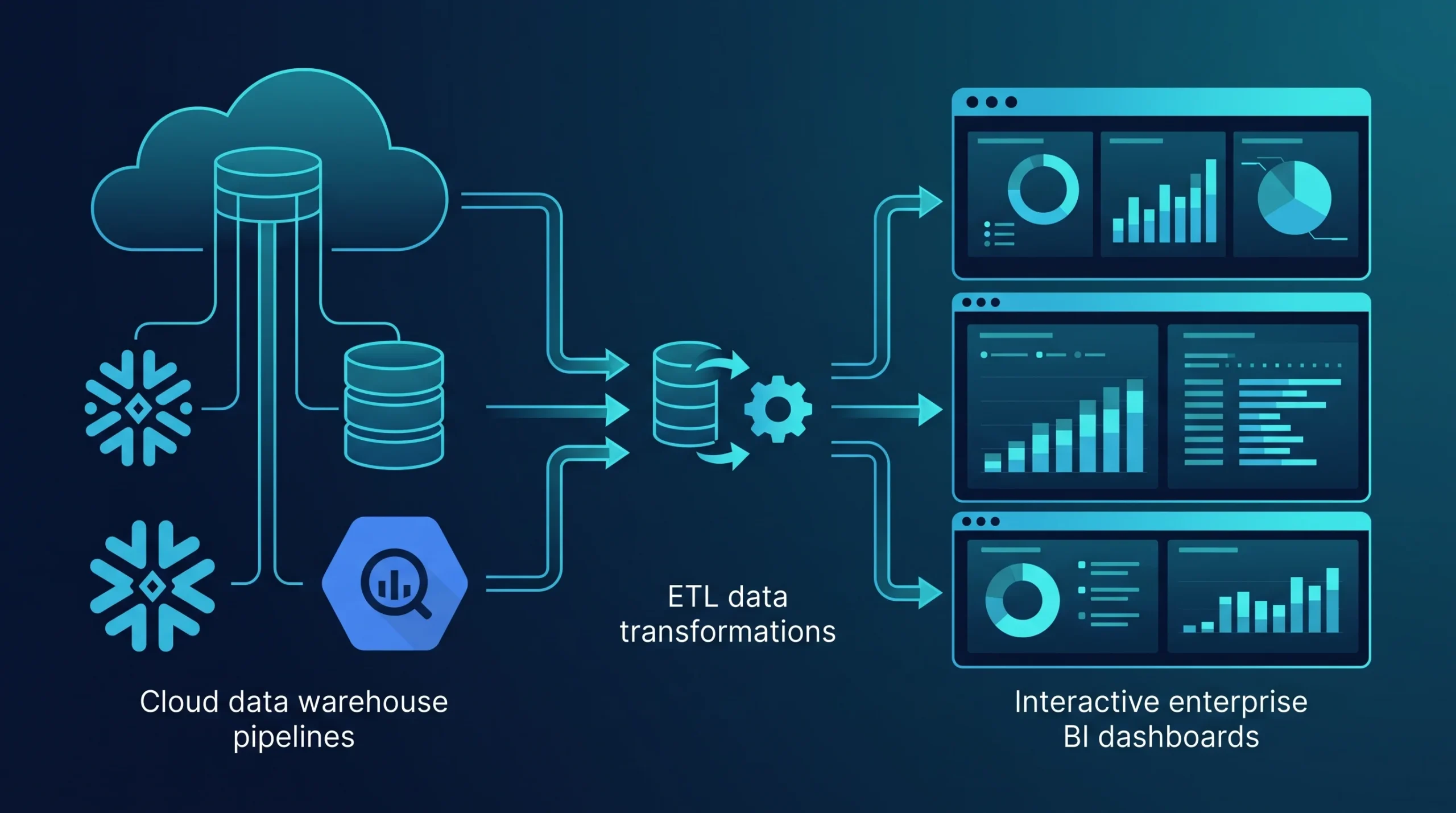
Navigating a structured bi developer roadmap is the single most effective way to transition into enterprise business intelligence engineering in 2026. In an enterprise landscape inundated with petabytes of operational data, organizations no longer struggle with collecting information—they struggle with making sense of it. While operational databases hum with millions of daily transactions, executive decision-makers are frequently left asking fundamental questions: Which customer cohorts are driving churn? What is our true product gross margin after regional shipping subsidies? Where are supply chain bottlenecks stalling fulfillment? For verified technical documentation and standards, refer to Snowflake Cloud Data Warehouse Documentation.
This critical gap is bridged by the Business Intelligence (BI) Developer. Operating at the vital intersection of software engineering, data architecture, and commercial strategy, BI developers transform raw, disconnected database tables into reliable, automated, and visually compelling reporting engines.
If you are looking to advance beyond entry-level data analytics into an engineering-oriented specialty with six-figure compensation ceilings, greater job stability, and significant organizational impact, this comprehensive 2026 BI Developer Career Roadmap lays out the exact technical proficiencies, data architecture methodologies, and portfolio strategies you need to succeed.
BI Developer Roadmap: What Modern BI Engineers Actually Do
A Business Intelligence Developer is a specialized data engineer and reporting architect. Unlike generalist data analysts who spend significant portions of their day conducting ad-hoc audits or calculating one-off summary statistics, a BI developer designs and maintains the enterprise analytics infrastructure that enables hundreds of business users to query data reliably on their own.
On any given workday, a BI developer might design an automated data extraction pipeline from Salesforce, model a star-schema data warehouse in Snowflake or Google BigQuery, write optimized SQL views, author complex DAX calculations for financial reporting, and design responsive executive dashboards in Power BI or Tableau.
Core Responsibilities of Modern BI Developers
- Data Modeling & Warehouse Design: Designing Kimball dimensional models, creating fact tables, dimension tables, and establishing surrogate keys to optimize query speeds.
- ETL/ELT Pipeline Orchestration: Building automated workflows that extract data from CRM systems, ERPs, and web platforms, transform raw inputs, and load cleaned datasets into enterprise warehouses.
- Semantic Layer Architecture: Constructing centralized business logic models where metrics like “Net Revenue” and “Active User” are calculated identically across every corporate report.
- Dashboard Development & UX: Creating interactive, drill-down executive dashboards with sub-second latency for executive leadership and operational managers.
- Performance Tuning & Governance: Profiling slow-running queries, partitioning large tables, managing Row-Level Security (RLS), and ensuring compliance with data governance standards.
Want to evaluate how BI developer salaries compare to data scientists and data analysts in your target market? Use our free Tech Salary & Bootcamp ROI Calculator to model compensation curves, tax deductions, and career investment returns.
BI Developer Roadmap: The 4-Layer Modern Data Architecture
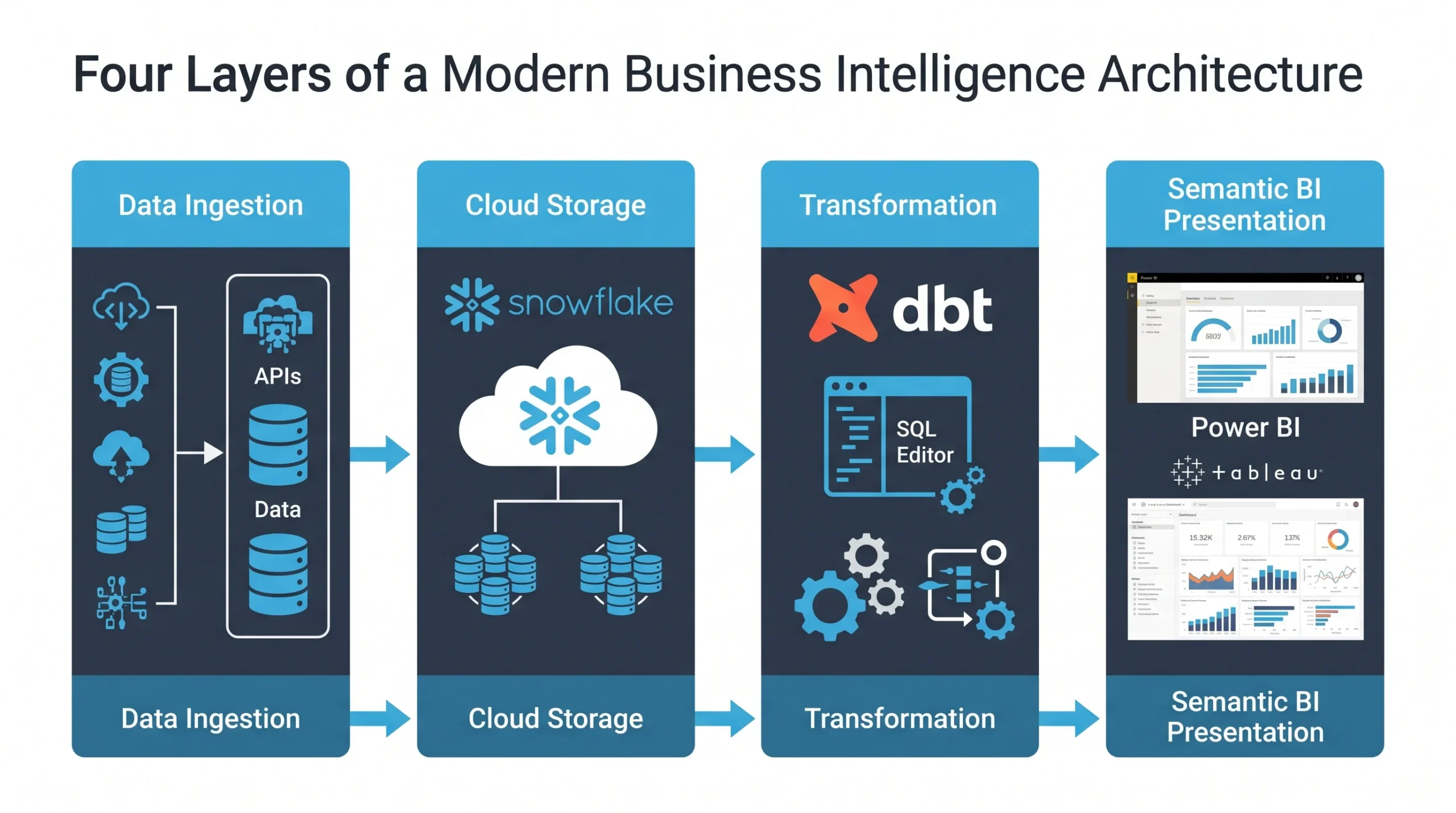
To understand the BI developer roadmap, you must understand the architecture of modern enterprise analytics. Every production-grade business intelligence ecosystem operates across four interconnected tiers:
BI Developer Roadmap Layer 1: Ingestion & Automated ELT
The first milestone in any complete bi developer roadmap is understanding automated raw data extraction and ingestion.
Modern organizations extract data from dozens of disparate systems: PostgreSQL transactional databases, Stripe payment APIs, Google Analytics events, and Salesforce CRM records. Modern BI developers leverage cloud ingestion tools (like Fivetran, Airbyte, or custom Python scripts) to replicate raw data directly into the cloud data warehouse without premature transformations.
BI Developer Roadmap Layer 2: Cloud Data Warehousing & Storage
Stage two of our bi developer roadmap focuses on central storage architecture in platforms like Snowflake and BigQuery.
The centralized storage repository where structured data resides. Modern BI development takes place almost exclusively in cloud data warehouses such as Snowflake, Google BigQuery, Amazon Redshift, and Databricks. BI developers must understand compute-storage separation, clustering keys, partitioning, and columnar storage mechanics.
BI Developer Roadmap Layer 3: Dimensional Modeling & dbt
Data modeling using Kimball star schemas is the architectural backbone of this bi developer roadmap.
Raw data is messy, duplicative, and poorly structured for business querying. In this layer, BI developers apply dimensional modeling principles using SQL and dbt (data build tool). Raw records are cleansed, standardized, joined, and organized into standardized Fact and Dimension tables that mirror real-world business activities.
Layer 4: Business Intelligence & Semantic Presentation
The final layer where business stakeholders interact with data. Using tools like Microsoft Power BI, Tableau, or Looker, BI developers build semantic models, configure relationships, write calculation logic (such as DAX or Tableau calculated fields), and design intuitive visual dashboards with role-based data security.
Step-by-Step BI Developer Roadmap for 2026
To transition from complete beginner or junior analyst into an enterprise-ready BI Developer, follow this structured, 4-phase technical roadmap.
Phase 1: Advanced SQL & Relational Database Mastery (Months 1 – 2)
SQL is the foundational lingua franca of business intelligence. While junior analysts stop at basic filtering and single-table aggregations, a BI developer must write performant, production-ready SQL scripts capable of processing billions of records efficiently.
- Complex Joins & Set Operations: Master INNER, LEFT, RIGHT, FULL OUTER, and CROSS joins, as well as UNION ALL and INTERSECT mechanics.
- Common Table Expressions (CTEs) & Subqueries: Structure maintainable multi-step data transformations that non-technical engineers can audit easily. Follow our structured guide: How to Learn SQL in 30 Days.
- Analytical Window Functions: Fluency with
ROW_NUMBER(),RANK(),DENSE_RANK(),LEAD(),LAG(), and rolling aggregation frames (ROWS BETWEEN UNBOUNDED PRECEDING AND CURRENT ROW). - Query Optimization & Indexing: Reading
EXPLAINexecution plans, understanding B-Tree indices, avoiding full table scans, and eliminating costly cartesian joins. - Stored Procedures & Views: Creating reusable stored procedures, materialized views, and user-defined functions in PostgreSQL or SQL Server.
Phase 2: Dimensional Modeling & Data Warehouse Architecture (Months 2 – 3)
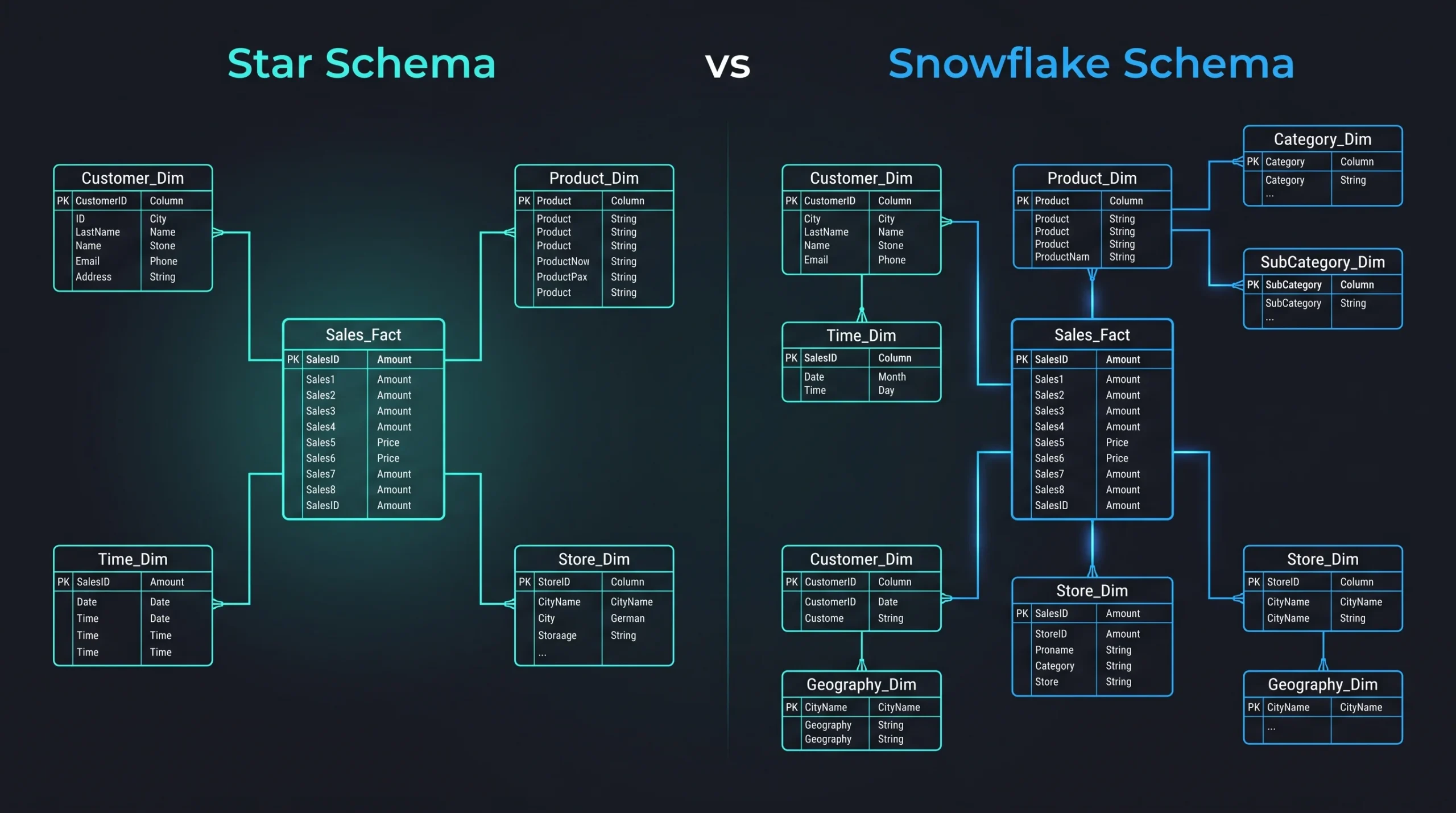
This phase is what truly separates a high-earning BI Developer from a standard dashboard designer. Dimensional modeling, pioneered by Ralph Kimball, is the science of structuring data specifically for analytical querying and reporting performance.
- Star Schema vs Snowflake Schema: Understand why star schemas are preferred for modern BI front-ends due to reduced join overhead and simplified DAX relationships.
- Fact Tables vs Dimension Tables: Distinguish between transactional facts (sales revenue, order items, web events) and descriptive dimensions (customers, products, calendar dates, store locations).
- Slowly Changing Dimensions (SCD): Master handling dimensions that change over time:
- SCD Type 1: Overwriting historical values (no history tracked).
- SCD Type 2: Creating new version records with effective date ranges (full historical auditability).
- SCD Type 3: Adding previous-value columns for point-in-time tracking.
- Surrogate Keys vs Natural Keys: Implementing synthetic integer surrogate keys to insulate the data warehouse from upstream application database ID changes.
- Granularity Definition: Formally identifying the exact business event that represents one single row in a fact table before writing code.
Phase 3: Modern Data Stack (Snowflake, BigQuery & dbt) (Months 3 – 4)
Modern BI developers do not rely on fragile, legacy desktop tools. They orchestrate transformations in the cloud data warehouse using modern developer workflows.
- Cloud Data Warehousing (Snowflake / BigQuery): Understanding virtual warehouses, micro-partitioning, time-travel data recovery, zero-copy cloning, and cost management policies.
- dbt (Data Build Tool): The industry-standard tool for data transformations. Learn how to write modular SQL models, configure Jinja templating, build automated data tests (unique, not null, relationships), and auto-generate interactive documentation catalogs.
- Version Control with Git: Managing analytics codebases via GitHub, handling branches, writing pull requests, and participating in code reviews like software engineers.
- Python for Analytics Automation: Writing Python scripts with libraries like Pandas and SQLAlchemy to connect to external REST APIs and automate routine operational tasks. Explore our Python for Data Analysis Roadmap for focused library learning.
Phase 4: Enterprise BI Tool Specialization (Months 4 – 5)
While familiarity with multiple visualization platforms is helpful, achieving top-tier compensation requires deep, specialized mastery of at least one dominant enterprise BI platform.
| Platform | Core Strengths | Primary Logic Language | Ideal Target Companies |
|---|---|---|---|
| Microsoft Power BI | Seamless Microsoft 365 / Azure integration, low licensing costs, dominant enterprise adoption. | DAX (Data Analysis Expressions) & Power Query (M) | Fortune 500 corporations, financial institutions, enterprise healthcare, retail. |
| Tableau | Superior visual design aesthetics, advanced exploratory geospatial mapping, massive community. | Tableau Calculated Fields & Level of Detail (LOD) Expressions | Tech startups, media organizations, consulting firms, SaaS enterprises. |
| Looker (Google Cloud) | Code-based modeling layer (LookML), centralized governance, in-database processing. | LookML & SQL | Modern cloud-native tech companies and high-growth venture-backed startups. |
Need help deciding between the market leaders? Review our in-depth head-to-head analysis: Power BI vs Tableau: Which to Learn First?.
For Power BI candidates, prioritize mastering DAX (Data Analysis Expressions): understand row context versus filter context, master the CALCULATE() function, time-intelligence calculations (Year-to-Date, Same-Period-Last-Year), and dynamic semi-additive measures.
BI Developer vs Data Analyst vs Data Engineer
Job titles in the data industry frequently overlap. Here is how the BI Developer role cleanly fits between analytical consumers and backend infrastructure engineers:
- Data Analyst: Primarily a business consumer of data. Focuses on exploratory analysis, answering specific commercial questions, and evaluating business KPIs. Usually relies on datasets prepared by others.
- BI Developer: The architect of the reporting layer. Designs data models, creates production ETL pipelines, automates semantic data definitions, and builds enterprise-grade reporting systems.
- Data Engineer: The backend pipeline engineer. Focuses on big data infrastructure, real-time Kafka streaming, distributed computing (Spark), API construction, and raw database availability.
To explore a holistic timeline for transitioning across any of these high-demand specializations, generate a customized milestone schedule with our interactive Career Roadmap Planner.
Salary Expectations & Compensation Breakdown
Because BI Developers possess both technical engineering capabilities (SQL, data warehousing, dbt) and executive business communication skills, their compensation significantly exceeds traditional reporting analyst roles.
- Junior / Entry-Level BI Developer (0 – 2 Years): Base salary ranges from $75,000 to $92,000 in the United States.
- Mid-Level BI Developer (2 – 5 Years): Base compensation climbs to $100,000 – $125,000, often supplemented with annual performance bonuses of 8% to 15%.
- Senior BI Developer / BI Architect (5+ Years): Base salaries reach $135,000 to $175,000+, with tech firms and hedge funds offering equity grants that push total compensation past $200,000.
How to Build an Unbeatable BI Developer Portfolio
Resumes listing generic buzzwords are routinely filtered out by hiring managers. The fastest way to secure interviews is providing tangible proof of your technical competence through end-to-end projects hosted on GitHub.
A winning BI Developer portfolio should avoid superficial single-file CSV dashboards and instead showcase complete, production-style pipelines:
- End-to-End E-Commerce Data Warehouse: Ingest an open-source retail dataset into Snowflake, build a star-schema dimensional model with dbt (including automated schema testing and documentation), and construct a Power BI executive sales dashboard with DAX time-intelligence metrics.
- SaaS Subscription & Churn Dashboard: Model recurring revenue metrics (ARR, MRR, churn rate, cohort retention curves) with Slowly Changing Dimensions (SCD Type 2) tracking customer plan upgrades.
- Healthcare or Financial Operations Tracker: Build a multi-page dashboard featuring Row-Level Security (RLS) simulating privacy controls where hospital clinic managers can only inspect their department’s data.
Looking for free datasets and project ideas tailored to specific industries? Use our free Portfolio Project Generator to get started immediately.
Frequently Asked Questions (FAQ)
1. Is a BI Developer a software engineer or a data analyst?
A BI Developer sits directly between both disciplines. While you do not build customer-facing web applications like a traditional software engineer, you apply software engineering best practices (version control, data modeling, automated testing, CI/CD) to business reporting and analytics architecture.
2. Do BI Developers need to know Python?
SQL is your primary language and is completely mandatory. However, intermediate Python skills are increasingly expected in modern roles for interacting with REST APIs, automating data warehouse ingestion scripts, and scripting complex data transformations.
3. Which certification is most valuable for a BI Developer?
The most respected industry certifications in 2026 are the Microsoft Certified: Power BI Data Analyst Associate (PL-300) for Power BI specialists, the Snowflake SnowPro Core Certification for cloud warehousing, and the dbt Fundamentals Certification for modern dimensional modeling.
4. Will Business Intelligence Developers be replaced by AI?
Generative AI and natural language query interfaces (like Microsoft Copilot) can generate basic charts from clean data. However, AI cannot build reliable dimensional models, reconcile conflicting business logic across corporate silos, or audit source database anomalies. BI Developers who learn to leverage AI tools to write SQL and DAX faster will become significantly more productive rather than obsolete.
5. Can I transition from Data Analyst to BI Developer?
Yes, this is one of the most common and natural career progression paths in tech. To make the leap, focus on deepening your SQL from ad-hoc querying to dimensional modeling (star schemas), learn a cloud data warehouse like Snowflake or BigQuery, and adopt modern transformation tools like dbt.
6. What is the difference between ETL and ELT in modern BI?
In traditional ETL (Extract, Transform, Load), data was transformed by dedicated processing servers before being loaded into the database. In modern ELT (Extract, Load, Transform), raw data is extracted and loaded directly into high-powered cloud warehouses like Snowflake or BigQuery first, and transformations are executed directly inside the warehouse using SQL and dbt.
Published by the SkillRoadmaps Editorial Team | Updated for 2026 Industry Standards